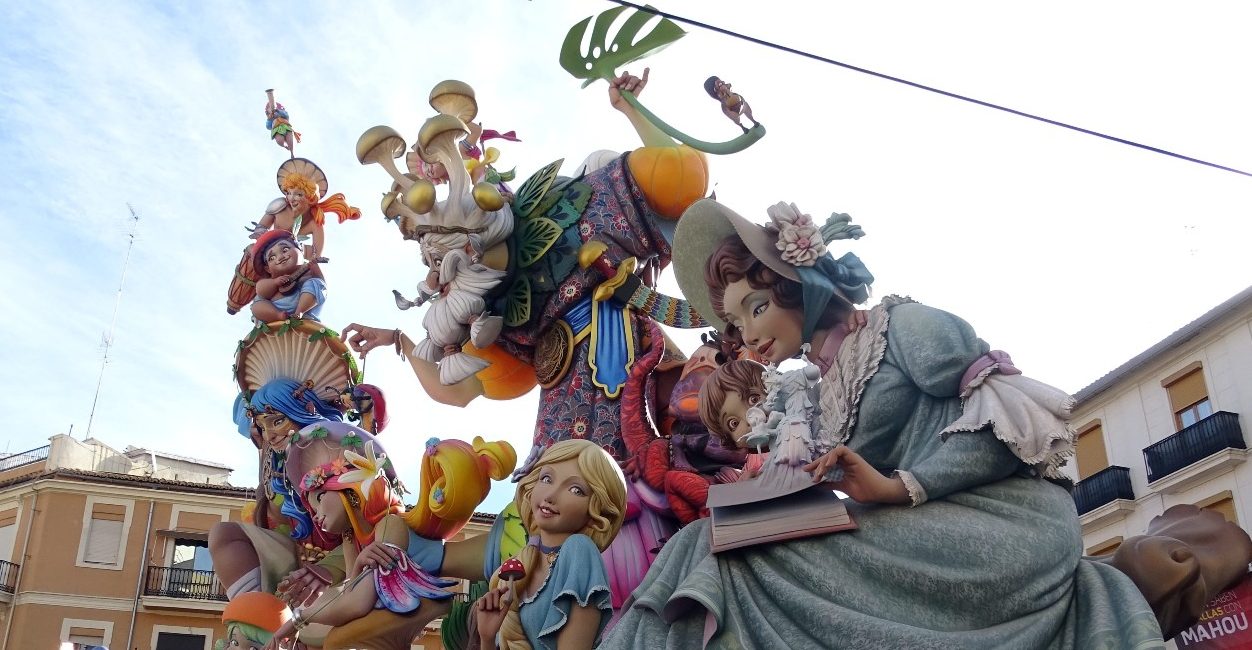
Many claim the Fallas of Valencia to be the best festival in the world (and, as a Valencian, I have to agree). The Fallas of Valencia are a true celebration for the senses: colourful ninots (figures), bands, firecrackers, churros and hot chocolate, flowers…
It’s a celebration that you should definitely experience at least once in your life, although not many people can resist coming again and again. So this Guide to the Fallas should help you to enjoy this festival as much as the locals do.
The origins of the Fallas
There are different versions of how the Fallas originated. One of the most widely known is the one relating to the carpenters of Valencia. The story goes that on 19 March, the carpenters used to burn their parots (lights made of pieces of wood with candles hanging off them) in the streets. Old, unwanted items were then added to them.
This event gradually evolved into the spectacular Fallas that we know today: large, colourful artistic monuments that are burned to mark the end of the festivities. A whole ritual of purification, of leaving the old behind and rebirth from the ashes.

Scheduling of the Fallas 2026
The dates of the main days of the Fallas of Valencia are always the same: 15-19 March. However, the atmosphere of the Fallas starts to build in the city well before this. The Crida in the Serrano Towers takes place on the last Sunday in February. This is the proclamation that announces the start of the Fallas every year.
From 1 March, the traditional mascletà takes place every day in the Plaza del Ayuntamiento (always at 2pm, without fail). Generally speaking, a mascletà is a barrage of pyrotechnics that increases in intensity, with different rhythms and lasting several minutes. The starting gun for the mascletà is set off by the Fallera Mayor (the queen of the Fallas) from the Town Hall balcony, as she says: Senyor pirotècnic, pot començar la mascletà! (Mr Pyrotechnic, you may commence the mascletà!). It gives me goosebumps every time I hear it!

Let’s skip to the morning of 15 March, and the Plantà (installation) of the fallas infantiles, thechildren’s fallas (smaller monuments with themes relating to childhood and which were originally created by the children themselves). This means that they have to be fully assembled by now. That same day, the Ninot Indultat del año (the pardoned ninot of the year) is announced. This is the only figure or monument that will be spared from the fire. Also, in the evening, the last touches are made to the fallas to arrive at their Plantà in time, on the morning of the 16th. The jury must deliver its verdict!
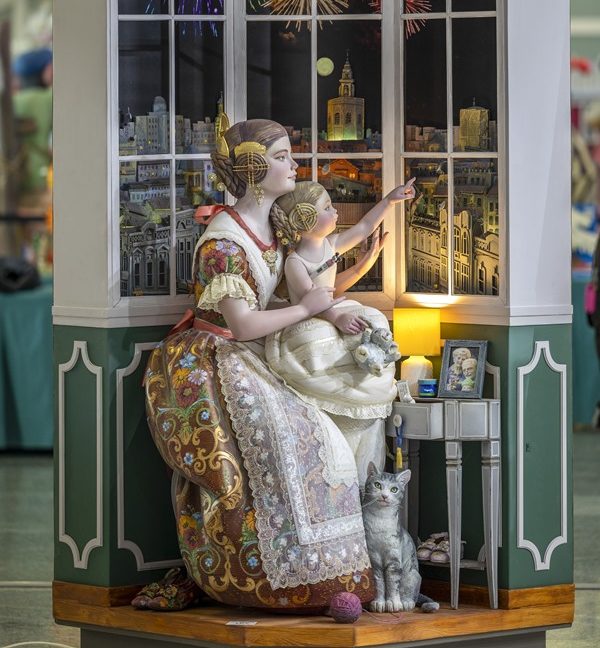
Later on the 16th, the prizes for the children’s fallas are awarded. On 17 March, those for the rest of the fallas are awarded and the Flower Offering to the Virgin begins. On the 18th the Offering continues and, once finished, the Nit del Foc (Night of Fire) takes place, with a spectacular firework display.
Finally, the 19th is the day of the Cremà (the burning), when all the fallas are burned. The children’s ones go first, followed by the rest.
10 tips for enjoying the Fallas like a local
The Fallas can be overwhelming. So many events, people and sounds can make you feel a bit bewildered. So here are the key tips for enjoying the Fallas like a Valencian:
Don’t forget your headscarf
There is one item that is practically obligatory to have with you during the Fallas: a Fallas headscarf, which is traditionally worn around the neck. And if you want to go a step further, you’ll need to equip yourself with a Fallas smock, and you’ll look like a true Fallas professional!
Get used to the noise
The Fallas are synonymous with gunpowder and, consequently, noise. And when we Valencians smell gunpowder, we tend to say ‘It smells like the Fallas!’. Mascletàs, fireworks, firecrackers of all kinds… the noise is incessant.
We are used to it, but it’s true that it can come as a bit of a shock to anyone coming to the Fallas for the first time. So I would recommend that, before you come, you watch some videos of mascletàs to get an idea of what to expect. And bear in mind that you’ll be hearing firecrackers going off all day long.
Experience the most spectacular fallas
Draw up a plan, either on paper or on your phone, with the fallas you want to visit. In these, I would include those in the Special Section, which are the most spectacular, and the fallas nearby to you that are of a high category.

This year, in 2024, the Special Section fallas, which you therefore can’t afford to miss, are the following. Their names indicate the places where they are installed (normally a square or where two streets meet).
- Falla Na Jordana
- Falla Convento Jerusalén-Matemático Marzal
- Falla Almirante Cadarso-Conde Altea
- Falla Exposición-Micer Mascó
- Falla Cuba-Literato Azorín
- Falla Plaza del Pilar
- Falla Sueca-Literato Azorín
- Falla Regne de Valéncia-Duc de Calàbria
- Falla L’Antiga de Campanar
Although they’re all amazing, I personally never miss the Falla Plaza del Pilar. This is erected in such a narrow little square that the size of the falla is accentuated even more and it always makes my jaw drop!
Incidentally, don’t forget about the children’s fallas; they have a unique charm and attention to detail!

Mascletà from the front row
If you want to feel the thrill of a mascletà up close, I recommend you get to the Plaza del Ayuntamiento nice and early. That will guarantee you a front-row view.
The balconies, for a view from above, are highly sought after. It’s true that watching from one of them is amazing, but the atmosphere in the street and being able to feel the ground tremble under your feet is priceless!

The mascletà in the Plaza del Ayuntamiento is not the only one to take place. You can go to others in different parts of the city (even at different times).
The best views of the Nit del Foc
The Nit del Foc (or Night of Fire), on 18 March, is one of the highlights of the Fallas. This is when you’ll see the main firework display. The crowds gather along the Jardín del Turia, from where it is set off. For the best views, get there fairly early and find a spot with no trees in the way.
The party is in the street
Forget about clubs and enclosed spaces. During the Fallas, the real party is in the street. There are numerous festivities organised in different parts of the city. One of the most popular areas is the Ruzafa neighbourhood, where you’ll also find several of the Special Section Fallas!

Feel the emotion of the Offering
The Offering of Flowers to the Virgin is of course an act relating to the Catholic religion, but, whatever your beliefs, I guarantee that you’ll find it beautiful. Seeing the falleras (the women in their traditional costumes) moved by the occasion, the bands parading, how the Virgin’s cloak is added to bit by bit…
As well as watching the gradual process, I like going on the night of the 18th after the Nit del Foc firework display. By then, the offering has come to an end, so the Virgin’s cloak is now full of flowers. The Plaza de la Virgen smells so fragrant that night!

Take a break from the Fallas in the Albufera
If you’re spending several days in the city enjoying the Fallas to the full, you may need a bit of downtime. If so, I suggest you go to the Albufera in Valencia.
This area is ideal for switching off and getting away from the noise of the firecrackers for a couple of hours and getting a breath of fresh air. It’s also one of the experiences to make you fall in love with Valencia.

Don’t miss the final burning of the Fallas
Many visitors put their heads in their hands when they find out that all the fallas are burned on 19 March, but for Valencians, that’s the essence of the festival. Otherwise, what would be the sense in creating new ones every year?
The cremà is a very emotional moment; it’s a bittersweet farewell because it means that the Fallas are over for another year, but that next year’s are just beginning. I would recommend that you see one or two. You don’t need to go to one of the main fallas; you can feel the emotion at any of the city’s burnings.
Bring your comfy trainers and be ready to walk
Believe me: you’ll walk miles at the Fallas. Forget about the car and, although you can use public transport, bear in mind that the bus routes are more limited and the underground will be packed, especially at peak hours. The best way to get around is on foot, so bring the most comfortable trainers you have to Valencia.
As you can see, at the Fallas of Valencia you won’t have time to get bored. I hope these tips are useful and encourage you to visit this spectacular festival, which leaves no one unmoved.