Easter in Asturias is marked by Semana Santa (Holy Week), with all its traditions, processions, festivities and other events. It’s the ideal time to live and breathe Asturias in a unique and special way, making the most of your holidays or just for a short break, whether in the city or in the countryside.
A bit of history
The history of Holy Week in Asturias is rich and ancient, dating back to the Council of Trent in the 16th century, which introduced important changes in the Catholic faith that were decisive in the origin of Holy Week as we know it today.
Brotherhoods began to emerge to relive the Passion and Death of Christ. The first of these was founded in Oviedo/Uviéu.
Gradually, during the Baroque period, Holy Week began to take root in Asturias. In 1682, the Royal Brotherhood of Our Father, the Good Jesus of Nazareth (Real Hermandad de Nuestro Padre el Buen Jesús Nazareno), began its activities in Luarca/Ḷḷuarca, where it founded a School of Christ.
The following centuries saw periods of greater or lesser splendour, and it was in the 20th century, in the 1940s, that the Brotherhoods re-emerged, only to recede in the 1960s and regain popularity in the 1980s and 1990s. As a result, Holy Week in Asturias today has numerous brotherhoods and processions that are experiencing real growth and renewed passion.

Curiosities of a unique Holy Week
Holy Week in Asturias keeps alive some interesting and joyous traditions. One is wearing something new for the first time on Palm Sunday.
Another beloved tradition is that on Easter Sunday, godchildren take palm leaves to their godparents, who hang them on their balconies or keep them at home until next year.
After receiving the palm leaf from their godchildren –or even if they don’t– godparents traditionally give them a gift at the end of Holy Week. Some still opt for a chocolate cake or figure, in shapes that change according to fashion, as well as typical Easter eggs or chocolate bunnies. Although the “bollo” –as it is called– does not necessarily have to be a sweet, it can be any other kind of gift.
Another colourful and tasty tradition is found in the windows and displays of confectioners’ shops, where the best works of their master chocolatiers are displayed, inspired by monuments, characters and all kinds of creations and reproductions.
When it comes to cakes, many towns in Asturias have their own traditional creations, such as the Roscón de Pascua from the mining regions, a puff pastry filled with almonds and meringue and decorated with coloured feathers, which can be several tiers high. The ancestor of this cake was the famous Pegarata, a bread roll in the shape of a cake containing boiled eggs, chorizo, bacon and ham.
Another very typical Easter pastry is the traditional Mantecado de Avilés or Mantecado Imperial de Avilés, traditionally given by the godfathers and godmothers of the city to their godchildren on Easter Sunday.
Not forgetting the fact that some brotherhoods have a tradition of serving a special lemonade with all these sweets, made with fresh lemon juice, home-made liqueurs and flavoured with cinnamon and sugar.

Fiesta season
Easter in Asturias promises to be full of events and attractions. Among these, the Asturias Festivals of Tourist Interest, some of which are held during the Easter holidays, deserve special mention.
These are: Holy Week in Avilés, Holy Week in Villaviciosa, the Living Stations of the Cross in Villanueva de Oscos, and the horse races on the beach in Ribadesella.
However, there are other places in Asturias where the Holy Week celebrations are intense and where you can enjoy the festivities to the full. These include Oviedo/Uviéu, Gijón/Xixón, Luarca/Ḷḷuarca (Valdés), Lluanco/Luanco (Gozón), Candás (Carreño), and L’infiestu (Piloña), among others.
Dozens of parades, processions, living Stations of the Cross, etc. fill the streets of towns and villages with a mixture of devotion and a unique festive atmosphere, always accompanied by unrivalled local cuisine.
After Passion Week two other festivities of great interest to tourists round off the holiday calendar: the Bollo in Avilés and the Painted Eggs (Huevos Pintos) in Pola de Siero.
The El Bollo Festival (Fiesta de El Bollo) originated at the end of the 19th century as an event of community life and popular participation to celebrate the arrival of spring and the end of Lent. They are held at the end of Holy Week, on Palm Sunday and Easter Monday.
The name of the festival comes from its gastronomic component, a buttered and iced sponge cake in the shape of a four-leaf clover called a Bollo. On Easter Sunday godparents treat their godchildren to a buttered bun in return for the palm leaf received on Palm Sunday. The Bollo is made with butter, flour, egg and sugar.

A large parade of decorated floats, giants and big-headed people, brass bands and folklore groups parade through the streets of the town at midday on Easter Sunday and in the afternoon on Easter Monday. The floats are designed and built by various community associations and reflect allegorical spring scenes or elements that represent the city. The festivities are rounded off by a variety of musical performances: Havanera choirs, Celtic music and open-air dances. Then at midnight, there are fireworks displays over the Ria.
On Easter Monday, a huge public cookout takes place in the streets of the Old Town and in the city’s parks. On average, twelve thousand people sit down to talk and eat food prepared at home or ordered from restaurants along a continuous line of tables stretching for more than four thousand metres through the streets of the Old Town. Younger people flock to the city’s parks to enjoy their meal out on the grass.
The Painted Eggs Festival in Pola de Siero (Fiesta de los Huevos Pintos) is always held on the Tuesday after Easter Sunday. From the early hours of Easter Tuesday, the centre of La Pola Siero takes on an incredible atmosphere, especially around the market, where dozens of stalls are decorated for the occasion, offering the chance to see and buy painted eggs, or Huevos Pintos, with a huge variety of decorations and sizes, although most of their designs and motifs are inspired by traditional Asturian culture, with many different sayings and symbols.

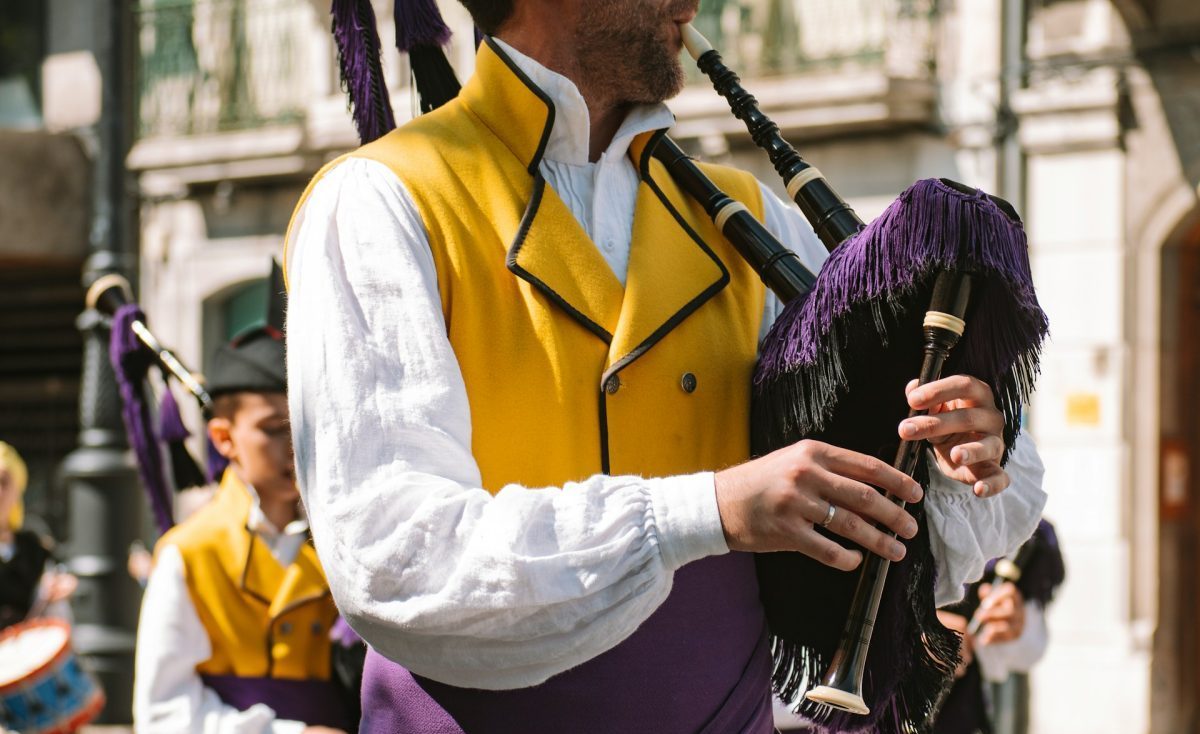
A very special moment of the festival is the blessing of the painted eggs in the square in front of the town hall, after which there is a celebration of cider, good food, bagpipes and revelry, which continues into the early hours of the morning.
Other options
In addition to the most typical processions and events of the season, Easter in Asturias offers many other alternatives.
The different museums and cultural spaces have a specific Easter holiday schedule.
For example, the Tito Bustillo Cave Art Centre (Ribadesella), the Jurassic Museum of Asturias (Colunga) and the Prehistoric Park of Teverga organise children’s workshops and activities for the whole family, as well as permanent and temporary exhibitions.

The Pre-Romanesque Centre, in Oviedo/Uviéu, also organises activities.
The Pepe el Ferreiro Ethnographic Museum in Grandas de Salime hosts live demonstrations of traditional crafts, children’s workshops and a temporary exhibition on the knowledge and role of women in the rural world of western Asturias.
Another option for an enjoyable Easter break is to take a guided tour of Laboral City of Culture, including going up to the viewpoint for a spectacular panoramic view.
And for a foodie experience, the Taramundi Cheese Fair is a good option.
Meanwhile, for nature lovers, Easter is the ideal time to indulge in outdoor activities and rural tourism.
An unforgettable Easter holiday in Asturias
Traditional fiestas, cultural visits, stunning spring landscapes… if you decide to spend Easter in Asturias, you are bound to find the perfect plan for you! Are you ready?