archive.php
Cycle routes that take you through rural landscapes, along ancient trails and coastal paths, revealing the more natural, authentic side of the island.

Menorca beyond the sea: an island waiting to be explored on two wheels

When we think of Menorca, we picture coves of turquoise waters, white sandy beaches and never-ending sunsets. But this little gem in the Baleares has much more to offer than its sea and coasts. Inland, you’ll find a patchwork of undulating fields, dry-stone walls, holm oak woods and villages where time seems to stand still. The tranquil countryside smells of fennel and rosemary, and the back roads invite you to explore them aimlessly.

And what better way to do this than by bike? Pedalling through Menorca’s interior is an active, adventurous experience that takes you into the true heart of the island. Between country lanes, ancient communication routes and historical paths, you’ll find a whole network of well signposted routes, with varying levels of difficulty, for you to ride at your own pace.

Why Menorca is a paradise for cycling enthusiasts

Menorca has been a Biosphere Reserve since 1993, and you can see this wherever you go. The island’s gentle topography, quiet roads and network of scenic paths make it the ideal destination for both experienced cyclists and those looking for an active break that’s not too challenging.

Inland Menorca combines surfaced roads with dirt tracks and paths surrounded by Mediterranean vegetation. In the space of a day you can go from farmland to hills with sea views or to forests with the smell of pine and salt in the air. The mild climate practically all year round also makes Menorca a perfect destination for cycling holidays out of season.
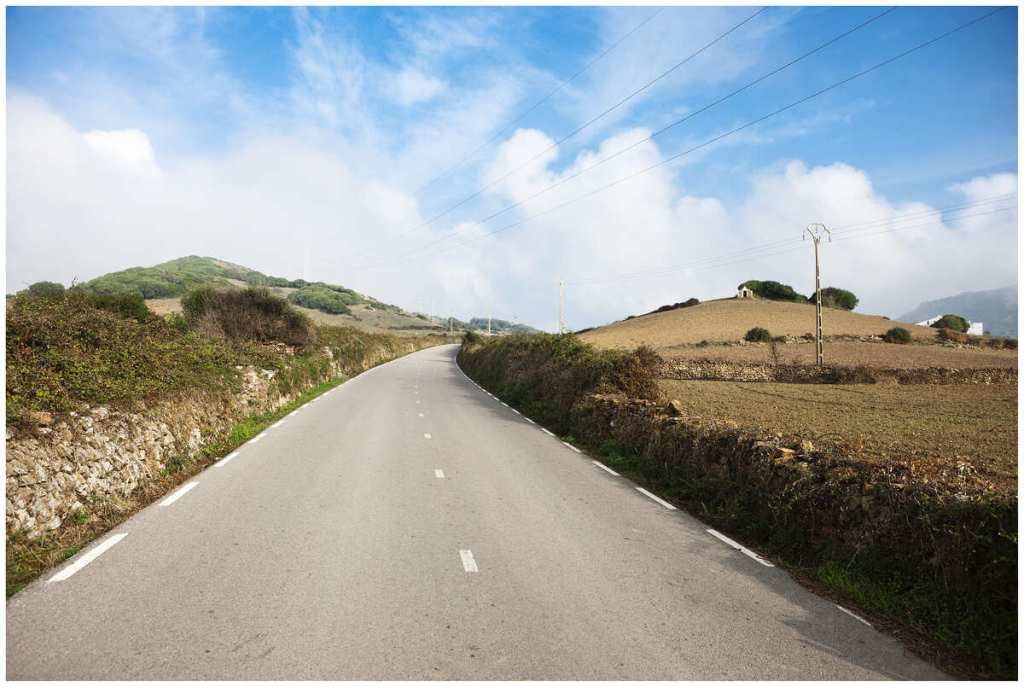
ruta Kane Menorca

Routes for discovering the interior and the most authentic landscapes

Here are some of the best routes for soaking up the essence of Menorca on two wheels. They’re all signposted, well-beaten tracks and designed for varying levels of ability.

 1. Ferreries – Es Mercadal (RC 02): between hills and vales

  • Distance: 16km
  • Difficulty: Moderate
  • Climb: 245m
  • Approximate duration: 1 hr 30 min

One of the most iconic routes in the centre of the island, linking two of its most authentic towns and crossing woodland, gentle hills and farmland. The ride winds through the central hills, with views of Monte Toro, the highest point on Menorca. Ideal for an active morning ride surrounded by nature.

cami de cavalls bicicleta menorca

 2. Es Mercadal – Alaior (RC 03): Menorca at its most rural

  • Distance: 7.3km
  • Difficulty: Moderate
  • Climb: 143m
  • Approximate duration: 45 min

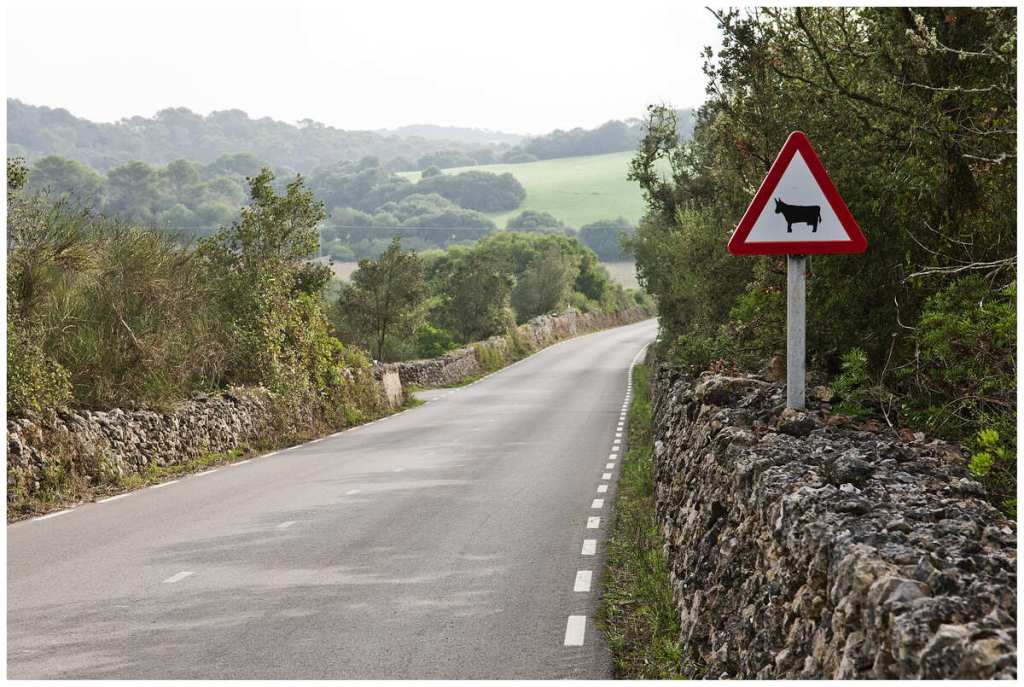
A short but very pretty route, crossing rural paths surrounded by dry-stone walls, olive groves and grazing cows. Perfect for those wishing to combine a bit of sport with some local tourism, stopping off at one of the cheese farms in the area to try the famous Mahón-Menorca cheese.

 3. Camí d’en Kane: the great cross-country route

  • Recommended section: from Es Mercadal to Maó
  • Approximate distance: 29km
  • Difficulty: Moderate
  • Climb: varies (around 300m)

Built in the 18th century by the British engineer Patrick Kane, this ancient communication route connected Maó with Ciutadella and is now one of the most iconic routes enjoyed by cyclists. It runs through the heart of Menorca, along its central axis, crossing fields, hills and small towns. It’s a journey back in time and into the scenic countryside of the island.
4. Ciutadella – Ferreries (RC 01): from the countryside to the sea

  • Distance: 18.7km
  • Difficulty: Moderate
  • Climb: 316m
  • Approximate duration: 2 hrs
ciutadella rincon bici

Ideal for those seeking a route that combines the interior with the charm of the coast. Starting from Ciutadella, the island’s former capital, it takes you inland across gentle slopes and shaded sections. Arriving at Ferreries, between the hills, you’ll find it the perfect spot for refuelling with an artisan ice cream or a coffee in the town square.

5. Maó S-01 / S-02: gentle rides in the south of the island

  • Distance: between 24km and 36km
  • Difficulty: Moderate
  • Climb: between 100m and 400m
  • Approximate duration: 1 hr 45 min – 2 hrs 45 min

Two routes start from Maó and tour the south of the island, between open fields, pine forests and paths leading to coves such as Alcaufar or Binibèquer. Both routes are accessible and extremely picturesque, ideal for a casual, unhurried ride, as you enjoy the sea breeze and the aromas of the countryside.

Cycling with respect: “guidelines for a good ride”

On Menorca, cycling is also a sign of respect for nature. Many paths cross protected areas and fragile ecosystems, and so the island has a simple set of rules for you to enjoy the environment without leaving a trace:

  • Keep to the signposted routes.
  • Don’t be noisy or frighten the animals.
  • Respect private property and barriers.
  • Moderate your speed and greet anyone you meet.
  • Wear a helmet and take some water and a basic repair kit with you.

Little things to make sure that others can also enjoy Menorca at its most natural.

dos ruedas bici con cartel cami de cavalls

Menorca, an island waiting to be discovered in the saddle

Cycling around Menorca is about much more than sport: it’s a way of connecting with the island’s rural soul and authentic heart. With every pedal stroke you’ll discover a different landscape: a herd of cattle crossing your path, a windmill on the horizon, a hidden cove at the end of a track.

On an island where you’re invited to take your time, your bike becomes the ultimate travel companion. So, adjust your saddle, get your map out and set off to discover inland Menorca, where every curve tells a story and every kilometre holds a new adventure.
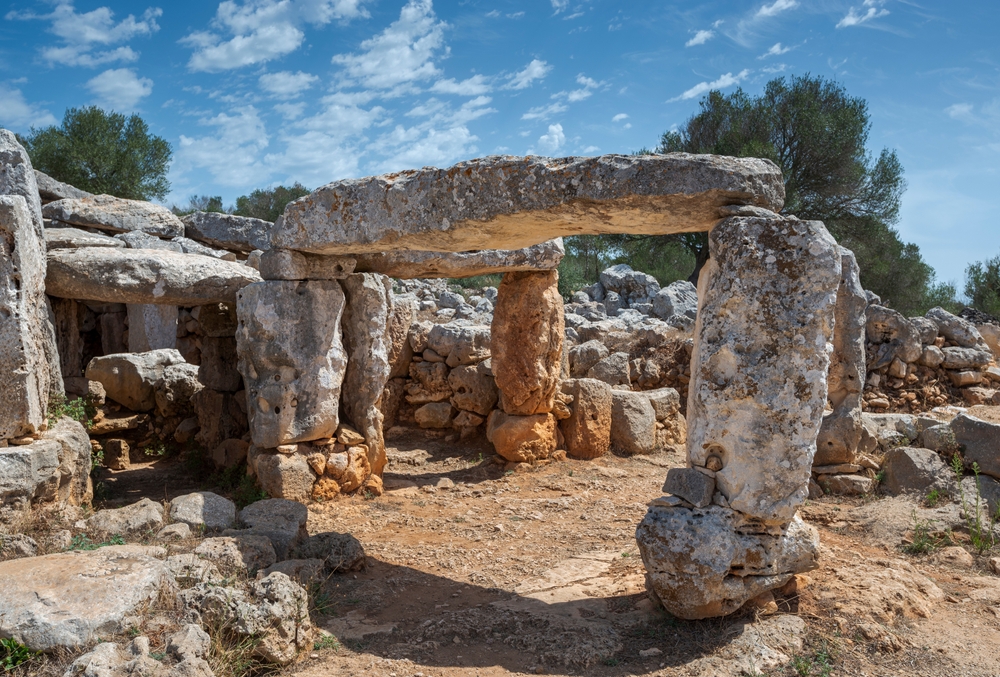
Visit megalithic structures and collective tombs dotted around the island’s landscape, an ancient testimony to a unique culture stretching far beyond the beautiful beaches.

There’s more to Menorca than its beaches of fine sand and turquoise waters; its 216 kilometres of coastline switch between sheer cliffs and golden coves, with activities that appeal to every kind of visitor. Declared a Biosphere Reserve on 8 October 1993, the island combines sustainable development with the conservation of a rich natural and cultural heritage. Aside from the summer, Menorca is a year-round destination: walks along the historic Camí de Cavalls, cycling routes, and a 0 km cuisine, with the lobster stew and Maó cheese being the stars of the show. One of the most amazing things about this wonderful island is its 1,600+ prehistoric monuments dotted all over the landscape, forming Talayotic Menorca, declared a UNESCO World Heritage Site in 2023 for its outstanding universal value.

Talayots: the cyclopean towers

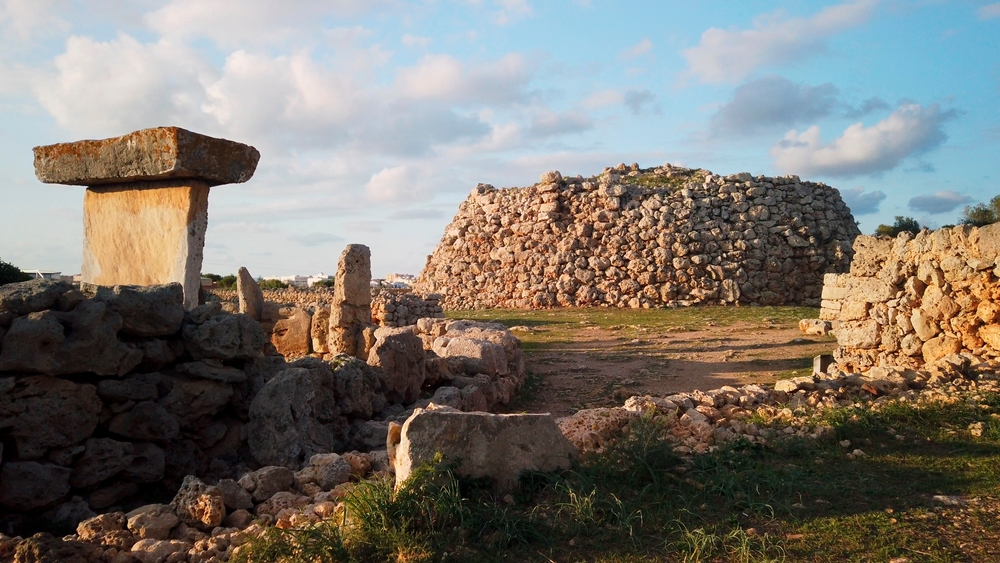
Talayots are circular or square megalithic tower-like structures, built without mortar from large blocks of limestone, up to five metres high and 25-30m in diameter. Erected between the 9th and 5th centuries BC, they were used as observation points, community centres and possibly ceremonial sites.

The main talayots and settlements

  • The Talayotic settlement of Trepucó (Mahón): covering an area of around 49,240m², this is one of the largest on Menorca. Only two talayots still stand today (1000-700 BC), along with the remains of the outer wall with two square towers, the taula enclosure (a religious structure featuring a T-shaped construction) and the remains of dwellings from the post-Talayotic period (650-123 BC). Its imposing taula, excavated in 1930 by the archaeologist Margaret Murray and subsequently restored with reinforcements (which are being questioned today), maintains its horseshoe shape and the large blocks of stone that make it one of the island’s most remarkable monumental sites. Recent excavations in the west part have brought to light polylobed houses with a central courtyard and peripheral rooms, whose sudden abandonment preserved various domestic utensils intact, and these are now on display in the Museum of Menorca. The largest talayot and the taula are also framed within a star-shaped dry-stone fortification, built in the 18th century during the siege of St Philip’s Castle.
  • Torre d’en Galmés (Alaior): the largest Talayotic settlement in the Mediterranean, with three talayots, a hypostyle room (room of columns), a rainwater collection system and a visitor centre. The settlement was inhabited from the Naviform period (1700-1400 BC) until Late Antiquity and also includes Islamic remains from the 12th century AD.
Torre d’en Galmés (Alaior)
  • Torralba d’en Salort (Alaior): renowned for its 4.3m-high taula, two talayots and underground silos, inhabited from the Bronze Age until Roman times.
  • Talatí de Dalt (Mahón): 4km from the centre, inner columns and burial caves can still be seen.
  • Settlement of Son Fornés (Es Mercadal): includes a talayot, necropolis and ceramic workshops, evidence of Talayotic everyday life.

Useful info

  • Access: all these settlements lie alongside the Me-1 road or local roads, with signposts and parking.
  • Visiting: most exteriors are free to access; Torre d’en Galmés and Trepucó charge an entry fee of between €3 and €6 with an optional audio guide.
  • Some tips: wear comfortable shoes, take water and suncream; the megalithic silhouettes are particularly beautiful at sunrise and sunset.

Navetas: boat-shaped tombs

Only in Menorca will you find navetas, collective tombs shaped like inverted ships. Built between 1050 and 850 BC, and so called as the word means ‘little ship’ in Catalan, they each have a small front entrance leading into a burial chamber.

Many navetas are in the open air, signposted and free to access, although the Naveta des Tudons has an entry free (€2) and set visiting hours. Plundering and early excavations reduced the information available, and current research is therefore focused on contextual studies and non-invasive exploration.

Must-sees

  • Naveta des Tudons (Ciutadella): the oldest fully preserved prehistoric monument in Europe, where bone remains and grave goods were discovered; entry costs €2, hours: 10:00–18:00.
Naveta des Tudons
  • Navetas of Rafal Rubí (between Mahón and Alaior): two navetas, easily accessible, alongside the Me-1, free to visit.
  • Son Mercer de Baix (Ferreries): Son Mercer de Baix is the most iconic Naviform site on Menorca. Occupied from the Early Bronze Age (around 1400 BC) until the Talayotic culture (approx. 1000 BC), it consists of several boat-shaped dwellings. It rises above the Son Fideu ravine, in Ferreries, an enclave of outstanding natural beauty.
  • Biniparratxet Petit (gardens of Mahón Airport): the first stop on the megalithic tour for visitors flying to Menorca, with a hypostyle room and a central courtyard.

More megalithic highlights

Before the talayots came the dolmenic period (2100-1600 BC), with a passageway of dolmens such as Ses Roques Llises. Subsequently, taulas (600-300 BC), T-shaped megalithic structures, appeared in ritual enclosures: those at Trepucó, Torralba and Torretrencada are the best preserved. Lastly, the hypogea and burial caves (500-123 BC) at Cala Morell and Calescoves complete an outstanding burial landscape.

Trepucó
Trepucó

Archaeological tour from east to west

  1. Biniai Nou (neolithic tomb, 5km from Mahón)
  2. Talayot de Trepucó and taula of the same name (Mahón)
  3. Torre d’en Galmés (Alaior)
  4. Naveta des Tudons (Ciutadella)
  5. Torralba d’en Salort (Alaior)
  6. Calescoves and Cala Morell (coastal necropolis)
  7. Torretrencada (Ciutadella)

Spread this circuit out over 2 to 3 days to enjoy a few stops at unspoiled coves and local museums.

Museums and living experiences

The Museums of Menorca (Mahón and Ciutadella) house Talayotic ceramics, bronze jewellery and household utensils to complement the outdoor sites. Experimental archaeology workshops also enable you to carve stone or reproduce ancient ceremonies, an ideal activity for families and groups.

Menorca is the gateway to an open-air museum, the only one of its kind in the Mediterranean. Book your flights and see the prehistoric age come alive on the island: behind every talayot and naveta you’ll discover the ingenuity and spirituality of the communities that shaped this landscape over 3,000 years ago. Your Talayotic adventure awaits!

If you thought Menorca was just about pretty coves and sobrasada, then you’re in for a nice surprise. This little Balearic island harbours much more than its beaches with turquoise waters and colourful umbrellas. 

In the heart of this land of reddish soil, between holm oaks and wild olive trees, you’ll find sleepy towns that taste of the sea and the countryside, full of tales, whitewashed walls and green windows. Today we’re going on a tour of Menorca’s most picturesque towns.

Es Mercadal: the heart of the island

Es Mercadal not only lies in the geographical centre of Menorca, but it can also be considered its rural soul. Just picture it: low houses, olive-green shutters and the smell of toasted bread wafting from the open door of a kitchen. This is the perfect town for seeing the most authentic side of Menorca.

es mercadal menorca

Things to do in Es Mercadal: climb Monte Toro, the tallest point on the island (358m, so you don’t need to be an expert climber), from where you’ll get a 360º view of Menorca. And don’t miss the sanctuary at the top, finishing off with a delicious “ensaïmada” in the local restaurant at the viewpoint.

How to get to Es Mercadal: it’s halfway between Mahón and Ciutadella, well connected by the Me-1 main road. There are buses from both cities.

Fornells: delicious flavours of the sea

An old fishing village with a slower pace of life, Fornells is famous for its lobster stew, but seafood is not the only attraction.

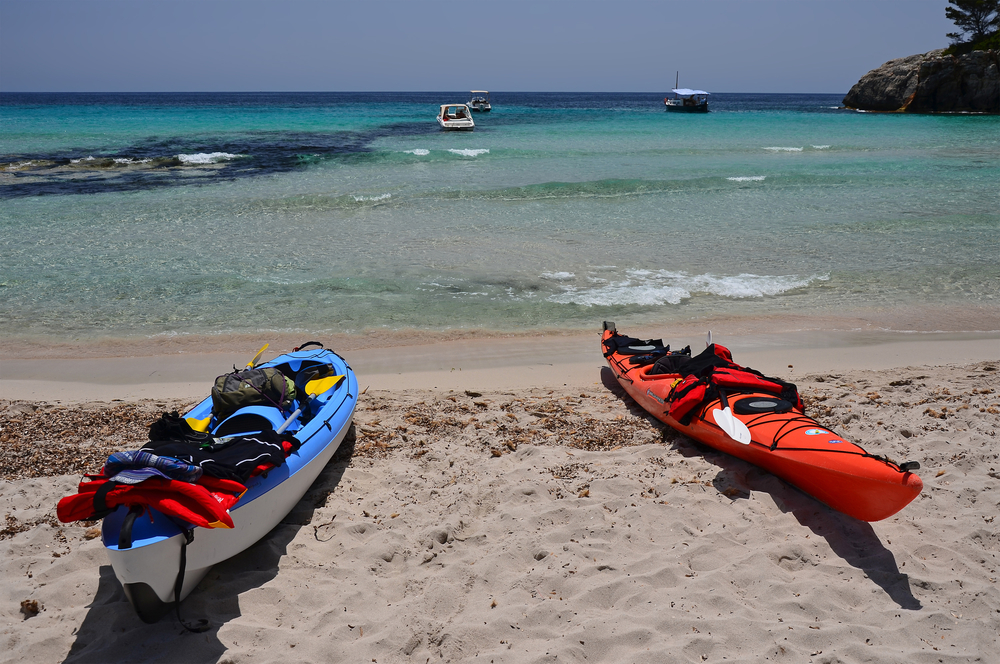
Things to do in Fornells: stroll around the harbour at sunset, with the boats bobbing in time with the Tramontana wind. If you’re up for a bit of adventure, why not hire a kayak or go paddle boarding to explore the bay. Or if you prefer something less energetic, you can visit the Fornells Tower, a British fortification with breathtaking views.

casas fornells

How to get to Fornells: it’s no more than 10km from Es Mercadal. You can go by car, bike or bus.

Sant Lluís: a little taste of France

With its different sounding name, Sant Lluís was founded by the French in the 18th century, and you can tell by its urban layout. Straight streets, low houses with an almost Provençal air… and a leisurely pace, ideal for visitors who like to take their time.

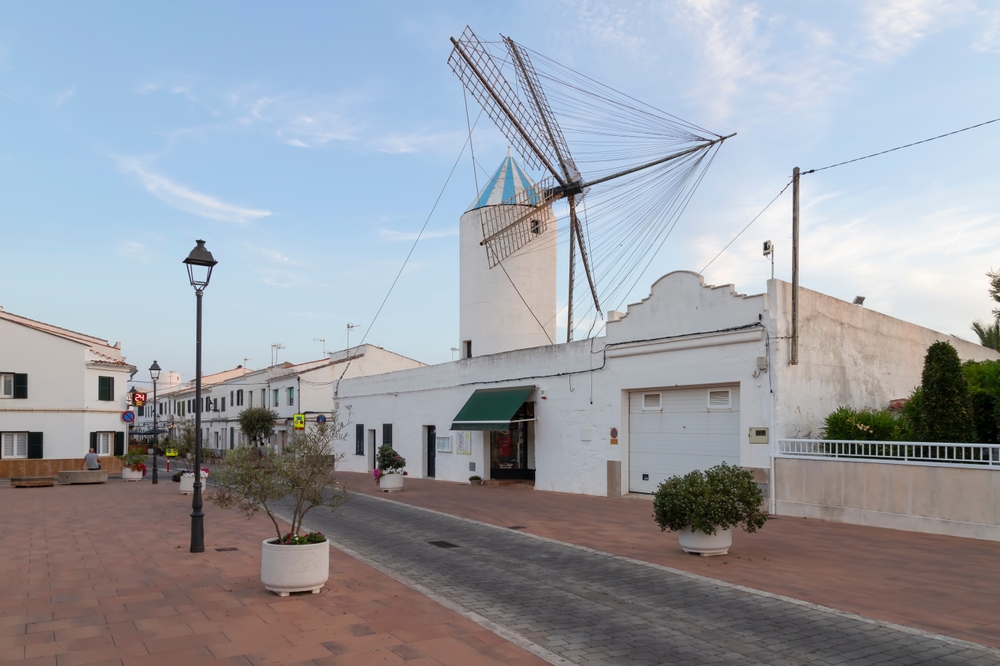
Things to do in Sant Lluís: Go and see the Molí de Dalt, a windmill that’s been converted into a small ethnological museum. Followed by coffee on a shaded terrace and a chat with the locals, who always have a story or two to tell.

sant lluis menorca

How to get to Sant Lluís: just 4km from Mahón by car or bus. You can also cycle there if you have the energy.

Alaior: art, cheese and alleyways

Alaior is like a snapshot of a Sunday afternoon: quiet, quaint and with memorable moments. The old town spreads out over a hill, with narrow streets, little steps and photogenic façades.

Things to do in Alaior: visit the church of Santa Eulàlia and wander around the local art galleries and charming little shops. And if you like cheese, you’ll find some of the island’s finest cheesemakers here. Ask for a taste and take some cured cheese home as a souvenir (wrapped up, so it doesn’t make your suitcase smell!).

How to get to Alaior: 12km from Mahón along the Me-1. There are frequent buses.

Ferreries: mountains and craftsmanship

Ferreries nestles among the green hills and has an artisan soul. Home to the famous Menorcan sandals, leatherwork is combined here with the stunning natural surroundings.

Things to do in Ferreries: visit the artisan shoe workshops and shops (it’s not all about cheap souvenirs). Walking routes lead from here to the Algendar Gorge, a walk through a leafy canyon, where you may spot the odd goat or falcon.

How to get to Ferreries: located between Es Mercadal and Ciutadella, along the Me-1. It’s well connected by bus.

ferreries menorca

Es Migjorn Gran: the least well-known town (and perhaps the most enchanting)

Es Migjorn Gran isn’t usually shown on the tourist maps… and maybe that’s why it’s so charming. It’s small, secluded and quiet. It has that air of a town where nothing ever happens, but in a good way.

Things to do in Es Migjorn Gran: take a stroll to the Sant Cristòfol hermitage and then find the local bar where they serve the best “pa amb oli” in the area (it’s debateable which bar this is, so you’ll need to try a few). The town is also very close to beaches such as Binigaus, which you can walk to.

How to get to Es Migjorn Gran: Between Ferreries and the south coast, accessible by local roads.

An island that takes care of itself (if you take care of it too)

Menorca has been a Biosphere Reserve since 1993, and that’s not just a nice title. It means that it is fragile, valuable and deserves to be treated with care. If you visit these towns, please remember: don’t make noise where silence reigns, buy locally, and take away only memories (and maybe a matured cheese).

Avoid places that are already too busy, such as Binibeca, to allow the island to breathe, and explore the less frequented corners. Because travel is also about making good choices in terms of where we go and how we do it.

For more ideas and info, take a look at our articles on Menorca.

Have a great trip, and may it be a beautiful one!

Menorca, that jewel in the Mediterranean renowned for its idyllic beaches and crystal-clear waters, is much more than a summer destination. The island has a wealth of cultural life and authentic local traditions that will enhance the experience of any visitor.  

Take a look at the calendar of festivals and cultural events held in Menorca throughout the year, especially in spring, autumn and winter, to discover its festive spirit and oldest traditions.

Festivals and sports and cultural events in Menorca throughout the year

All year round: Sport and wellness in nature

As well as its cultural calendar, Menorca has raised its profile over recent years as an ideal destination for those seeking sporting or wellness experiences in the natural surroundings. Its network of ancient paths, its hidden coves and unspoiled landscapes make the island the perfect setting for connecting with the environment and with oneself.

Trail Menorca Camí de Cavalls (May)

One of the key sporting challenges on Menorca’s calendar is the Trail Menorca Camí de Cavalls. This demanding trail running competition takes place along the ancient path that follows the coastline around the whole of the island (the GR-223), amounting to more than 185km across cliffs, forests and beaches. This event is about endurance and the beauty of nature, attracting runners from all over the world.

Volta Menorca BTT (October)

In autumn there’s an unmissable date for mountain bikers: the Volta Menorca BTT. This non-competitive event consists of spectacular biking routes along rural trails and coastal paths, combining sport, active tourism and the participation of riders of all ages.

Yoga Gallery festival: wellness with a view (June)

For those looking for a more tranquil experience, the island also offers wellness events such as The Yoga Gallery, a festival combining yoga sessions in natural spaces and heritage locations with music, art and healthy food. A perfect activity for connecting the mind and body with the landscape of Menorca.

You can find other events for lovers of sport and nature on the website of the Fundació Foment del Turisme de Menorca.

Spring: a cultural awakening

March to May: Menorca Jazz Festival

From March until May the Menorca Jazz Festival has a wide range of music experiences. The concerts are held in iconic venues, such as the Teatre Principal in Maó and the Teatre des Born in Ciutadella, as well as in outdoor spaces such as the Palmeral de Calan Blanes. In addition to the main performances, the festival includes street activities such as the Menorca Lindy Exchange, cinema screenings, workshops and the Festival Amalgama Kids, aimed at the younger ones. The 2025 festival starts on 6 March with a performance by Cécile McLorin Salvant, a renowned jazz artist. ​

MENORCA JAZZ FESTIVAL

April: Fish Gastronomy Days

As spring arrives, Menorca celebrates its wonderful cuisine with the Jornadas Gastronómicas del Peix. During this event, various restaurants on the island offer special menus based on local fish, allowing locals and visitors to taste the best of Menorca’s seafood cuisine.

May: Ópera en Maó season

The Teatre Principal de Maó, Spain’s oldest opera house, hosts the Opera Season organised by Amics de s’Òpera de Maó. In 2025, the season’s highlight will be “Aida” by Giuseppe Verdi, with performances scheduled for 30 May and 1 June. ​ ​

Autumn: tradition and documentaries

King’s Cup for Vintage Boats

At the end of August the port of Maó stages the prestigious Copa del Rey de Barcos de Época, an international regatta that brings together classic and vintage boats. It’s a unique opportunity to admire the elegance of these historical sailing crafts and to soak up the nautical spirit of the island. ​

COPA DEL REY VELA MENORCA

September: Cranc Festival in Maó

For lovers of indie and alternative music, the Cranc Festival has established itself as an unmissable date in the calendar. Held in Maó, this festival features a carefully selected lineup of both emerging and established bands, creating a vibrant and youthful atmosphere as summer in Menorca comes to a close. ​

CRANC FESTIVAL MENORCA
Credits: Javier Rosa

October: Menorca Doc Fest

With autumn comes the Menorca Doc Fest, a festival dedicated to documentaries and photography. Through screenings, exhibitions and workshops, this event encourages reflection and debate on different social and cultural topics, acting as a meeting space for creators and the general public. ​

menorca doc fest

Winter: charity and Christmas traditions

December: Gala “Por la sonrisa de un niño” (for the smile of a child)

During the month of December, Esplanada Square in Maó stages this benefit gala organised by Ràdio Menorca SER and the Spanish Red Cross. The aim of the event is to collect toys and donations to ensure that no child on the island is left without a present on Epiphany. The day is full of musical performances, workshops and activities for the whole family, reflecting the charitable spirit of the islanders. ​

Christmas markets in the towns of Menorca

During the month of December the towns of Menorca dress in all their finery to celebrate Christmas with their traditional markets. The streets and squares are full of lights, decorations and stalls selling a wide range of handicrafts, food products and Christmas items. These markets are not only ideal for finding special gifts but they also run cultural and leisure activities for the whole family, creating a warm, festive vibe that reflects the island’s community spirit.

Menorca is an island that’s full of life all year round, offering its visitors a perfect combination of idyllic beaches, charming villages, lush nature, hospitable people, delicious cuisine and long-lasting traditions. Come and soak up its culture and explore every corner of this wonderful island, where each season brings with it new experiences and festivities. ¡Vine i gaudeix de Menorca en tots els seus vessants!, or come and enjoy Menorca in all of its facets!

Menorca is not just a perfect picture-postcard location with secluded coves and golden sunsets; it’s also a living lab, exploring how tourism can coexist alongside nature without destroying it.  

The other side of paradise

Declared a Biosphere Reserve by UNESCO in 1993, this small Balearic gem champions sustainability, showing how a different kind of travel is possible. A slower, more aware and much more transformational kind of travel.

In a world full of destinations from which every last drop has been squeezed, Menorca is a breath of fresh air. Here, luxury lies in simplicity, rather than excess: the sound of the motor-free sea, the star-studded sky with no neon lights, and authentic, additive-free flavours.

Camí de Cavalls: hiking with soul

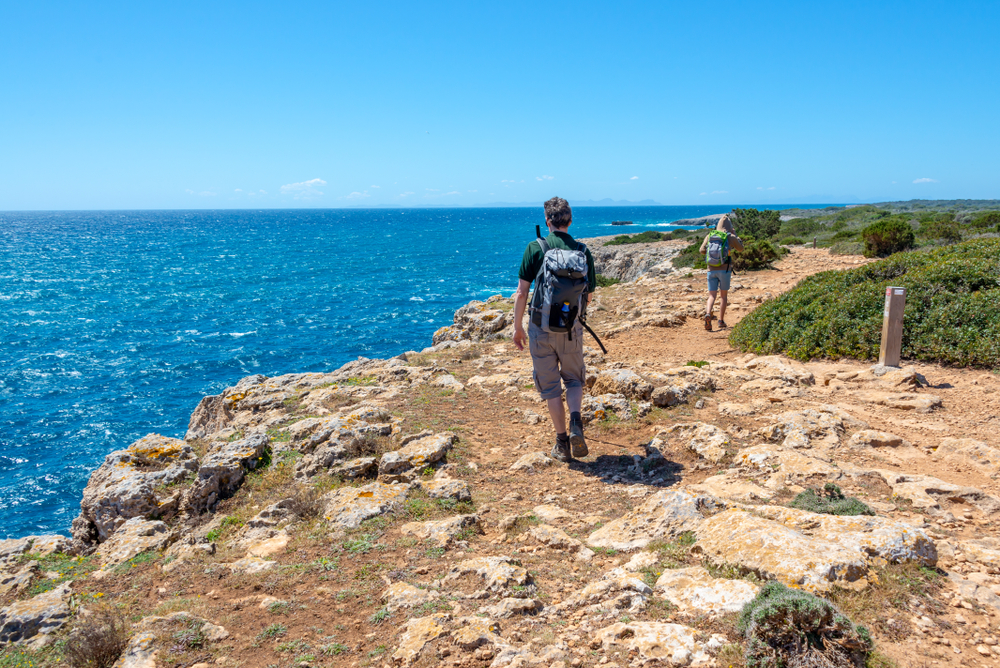
If you really want to get to the soul of Menorca, put on your walking shoes and set off on the Camí de Cavalls. This ancient military path, running around the 185 kilometres of the island’s coastline, is much more than merely a hiking trail; it’s a journey through time.

panorama cami de cavalls

Along this path you’ll discover hidden coves, where time seems to stand still, breathtaking cliffs and forests that whisper age-old tales. Whether you walk or cycle it, every stage invites you to connect with the landscape without intruding. Take away only your memories and leave only your footprints.

A useful tip: Download a route app (such as Wikiloc or Komoot) to follow the trail without getting lost and check the weather conditions before setting off. Take some water and local fruit with you to keep you going along the way.

Beaches that look after themselves… if you look after them too

In Menorca, you don’t invade the beaches; you discover them. Cala Macarella, Cala Escorxada or Cala Pregonda aren’t made for turning up in your car and parking right by the beach. They require some walking, exploring, getting there patiently. And that makes them more precious.

kayaks en una playa de menorca

These practically untouched coves form the heart of sustainable Menorca. But it’s a fragile balance. One single plastic container can remain in the sand for centuries. Protecting them starts with small gestures: not leaving litter, not smoking on the beach, avoiding toxic suncreams.

A useful tip: Take a bag with you to put your rubbish in, as well as anything else you might find lying around if you can. Use eco-friendly, biodegradable sun protection to avoid harming the seagrass, the underwater plant that keeps the water healthy and so transparent.

Sleeping well at night: accommodation with a purpose

You don’t need to sacrifice comfort to be a responsible tourist. In Menorca, you’ll find restored country farms, eco hotels powered by solar energy and small agritourism farms where you can enjoy a breakfast of Mahón cheese made just a few metres away from your room.

Staying in sustainable accommodation not only reduces your environmental footprint, but also helps to preserve traditions, landscapes and ways of life. And, at the same time, it enables you to enjoy a more authentic and human experience.

A useful tip: Look for accommodation that is Biosphere certified or that forms part of initiatives such as “Menorca Reserva de la Biosfera”. Many will enable you to learn about rural life first hand, take part in workshops or try the local produce.

Authentic eating: zero km and infinite flavour

Menorca is best savoured slowly. At a village market, in a traditional oven, at a small family-run winery. Its cuisine, with Arab, Catalan and British influences, is a reflection of its multi-cultural history.

queso mahon menorca

Opting for local produce is a delicious way of supporting the circular economy. Every piece of sobrasada, every sip of Xoriguer gin, every artisan cheese tells a story and avoids unnecessary transport emissions.

A useful tip: Always order seasonal dishes. Visit the markets in Mahón and Ciutadella and ask for “0 km” products. And don’t be afraid to try the unknown; it can often be the most delightful.

Menorca on the move: explore without polluting

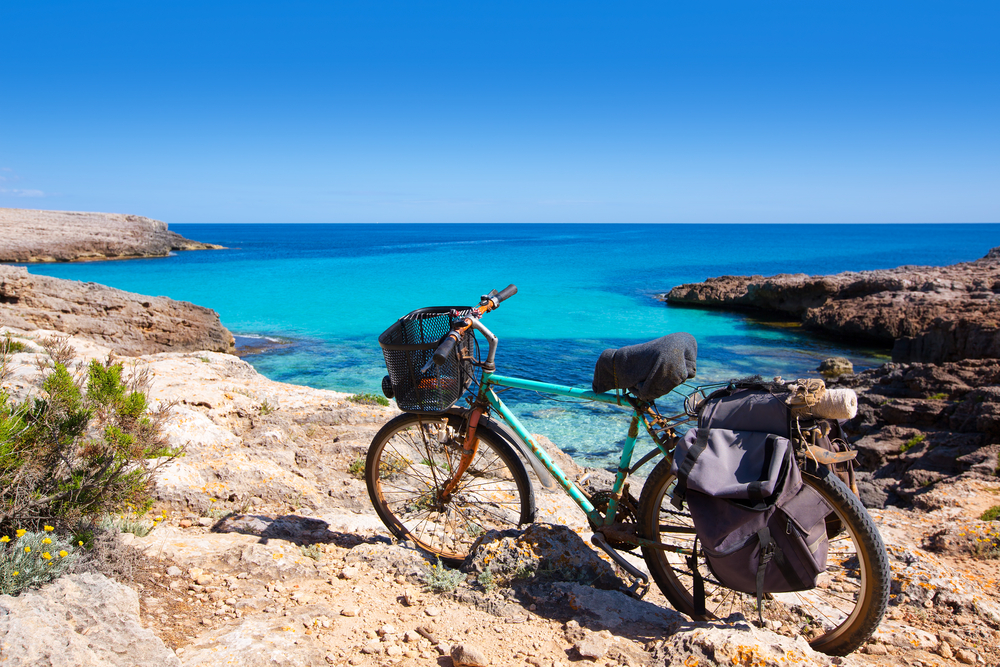
The best way to discover Menorca is at walking or pedalling pace. The island is covered in cycling and walking routes, so you can explore its charms without hiring a car.

The main locations are connected by public transport and many companies rent out electric bikes. So getting around becomes part of the adventure.

bicicleta costa menorca

A useful tip: If you do hire a car, make sure it’s electric, but it’s better to walk, cycle or take the bus if you can. Check the timetables for services in low season, as they may vary.

Beyond the summer: the beauty of off-season

Visiting Menorca in spring or autumn is an open secret among those who come in search of authenticity. The mild temperatures, peaceful paths and deserted beaches offer a version of the island only known to a few.

Off-season travel not only improves your experience but also helps to relieve the pressure on the environment during the peak months. It also allows the local population to diversify their economy throughout the year.

A useful tip: Check the calendar for local fiestas and cultural events. Many take place in spring or autumn and are a great way of discovering the true Menorca.

Your trip leaves a mark; make it a positive one

Every decision you make as a traveller has an impact. From the accommodation you choose to what you eat; from the transport you use to the beach where you lay your towel.

Sustainable travel is not about making sacrifices; it’s about making better choices. It’s about enhanced experiences, making real connections and meaningful memories. Menorca gives you the opportunity to do this. The question is: are you ready and willing to make this change?

Menorca, the quiet jewel of the Balearic Islands, becomes a peaceful haven during the autumn, winter and spring months.

When the summer crowds have disappeared, the island offers its visitors an authentic experience, where nature, culture and gastronomy complement one another in a relaxed atmosphere. So here is a guide that we’ve put together on how to enjoy Menorca in low season, by exploring its charming towns and villages, savouring the local cuisine and immersing yourself in invigorating activities.

Strolling through the charming towns and villages

Fornells

This quaint fishing village in the north of the island is known for its vast bay and whitewashed houses. In low season, Fornells retains its peaceful soul, inviting you to stroll around its harbour and enjoy the authentic local everyday life.

detalle casa Fornells

Es Mercadal

Lying in the heart of Menorca, Es Mercadal is the ideal starting place for exploring Monte Toro, the island’s highest point. Its narrow streets and traditional architecture make for a relaxing stroll, with artisan shops and welcoming cafés waiting to be discovered.

Culinary experiences in local restaurants

Menorcan cuisine is rich and varied, and many local restaurants stay open in low season, serving traditional dishes made from the island’s fresh produce. You’ll be able to try some age-old recipes and dishes that reflect the true essence of the island.

Beaches for walking

Whilst temperatures in low season are not (always) favourable for bathing, Menorca’s beaches are perfect for walking and relaxing, surrounded by stunning scenery:

Playa de Son Bou

With its vast stretches of sand, this beach is ideal for long walks along the shore. Its protected natural environment also makes it the perfect spot for birdwatching and connecting with nature.

Cala Mitjana

Surrounded by cliffs and pine forests, this beach has paths leading into the surrounding area, where you can enjoy some spectacular views of the Mediterranean.

acantilados cala mitjana menorca

Walking and wellness

Menorca in low season is the perfect place for walking, wellness activities, yoga and meditation. The calm that you sense on the island makes it easy to switch off and rejuvenate your body and soul.

Yoga retreats on Menorca

You’ll find many retreat options, offering daily yoga and meditation sessions, combined with activities such as dawn excursions and trips to archaeological sites. A wonderful opportunity for revitalising your body and mind in an unrivalled natural setting. 

Holistic wellness tourism

Menorca is an ideal destination for wellness tourism, with its protected natural environments that encourage meditation and reflection, promoting pro-environmental behaviour and responsible and mindful tourism.

Walking the Camí de Cavalls

This ancient path, circling the island for 185km, is a fantastic way of discovering its most spectacular landscapes. Originally used by soldiers in the 18th century, the Camí de Cavalls takes you past cliffs, pine forests and secluded coves. In low season, the cooler climate and lower number of tourists make this route even more enjoyable, allowing you to connect with nature in all its splendour.

cami de cavalls menorca

The climate in low season

During the autumn, winter and spring months, Menorca enjoys a temperate climate. Average temperatures range between 14°C and 20°C, with mild winters that rarely fall below 10°C. Rainfall is moderate, mainly concentrated in autumn. This pleasant climate means that outdoor activities, such as walking or cycling, can be enjoyed all year round.

faro menorca

Useful information

  • Transport: although flights may not be as frequent in low season, Menorca continues to be well connected with the major Spanish and European cities. Hiring a car is advisable to explore the island more freely.
  • Accommodation: there’s a wide range of rural establishments and boutique hotels offering comfortable accommodation in peaceful surroundings, and in low season you can find some very good deals.

By visiting Menorca in low season you can enjoy an authentic experience, where the peacefulness and natural beauty of the island can be appreciated to the full. Switch off and recharge your batteries in a unique environment!

The island of Menorca, the smallest island of the Balearics, is a favourite summer getaway for those who love the sea, nature and tranquillity.

CAMÍ DE CAVALLS: ABOUT IT

With its dozens and dozens of idyllic beaches and coves and the feeling of peace that it exudes, the island is undoubtedly ideal for those who are looking forward to a relaxing holiday and much more besides. It is an excellent destination for anyone who enjoys snorkelling, water sports, boat trips and above all excursions and walks.

panorama costa isola minorca

One of the main things so special about Menorca is that you can easily combine a nature walk with a pleasant spell on the beach, thanks to the Camí de Cavalls, the island’s most famous and longest walking route, running along the entire coastline and offering some wonderful walks and stunning scenery.

Read on for all the information on this magical trail, as well as a series of tips for organising your excursions. 

The history of the Camí de Cavalls

Camí de Cavalls (literally, “Way of Horses” in Menorcan) is just one of Menorca’s many footpaths, but it is undoubtedly the longest and most picturesque. It is actually a network of ancient paths, around 115 miles long in all, which circles the entire coast of the island.

Its original purpose was mainly defensive, to guard the Menorcan coast and to connect different parts of the island, which would be invaluable in the event of an attack. The oldest historical sources tell us that it was created on the instigation of King James II of Mallorca, who ordered its construction in 1331. 

As well as serving as a defence system, the trail was also used as a public footpath by the Menorcans, which was of great benefit to local trade.

As time went by, owing to the various military emergencies that arose over the centuries, and particularly after the Spanish Civil War, the Camí de Cavalls unfortunately began to deteriorate and “disappear”.

The Camí de Cavalls today

Owing to the determination of the Menorcans, in 2000 a regional law was enacted in an effort to restore the Camí de Cavalls and render it free and open to residents and visitors.

The restoration project, however, was only completed in 2010, and from that year onwards it has been possible to follow the entire trail. The Camí de Cavalls is still open to the public and is marked with special signs that indicate places of interest and their distances.

Furthermore, it is passable on foot or on horseback (and in some places by bike).

cami de cavalls minorca segnaletica

CAMÍ DE CAVALLS: STAGES AND EXCURSIONS

The Camí de Cavalls undoubtedly falls within the places not to be missed in Menorca: even following a small stretch of it will give you the chance to breathe and admire the authentic essence of the island.

One of the unique characteristics of this path is that, given that it coasts the entire island, it also passes through various types of landscape: ranging from green pastures to rocky landscapes or scenes of red earth, and from beaches with turquoise-blue waters to tarmac.

panorama spiaggia cami de cavalls

It is not the easiest path, particularly in certain places, but it is very picturesque and also the only way to reach some of Menorca’s totally unspoilt virgin beaches.

It is also a way to reach other less isolated but also extremely beautiful beaches, such as the pearls of the south Cala Galdana, Cala Turqueta and Son Bou. What could be nicer that diving into the water after having taken a long walk under the sun?

Stretches and distances

The Camí de Cavalls is currently divided into 20 stretches of various durations and levels of difficulty. The maximum height above sea level is 410 feet. Given that it is a circular trail, you can start at any point, although ideally it starts from Mahón.

The fittest can walk the entire trail in a minimum of seven days, but even novices can enjoy its beauty by choosing the easier stretches. However, it is a good idea to keep in mind that there are no tourist facilities along the route, nor is it permitted to sleep on the beach. Therefore, if you want to walk the whole path, you will have to rely on taxis or public transport to get back to your accommodation once you have finished each excursion.

trekking cami de cavalls minorca

We would also advise against attempting to walk the entire trail in the months of July and August, given that the temperatures on Menorca get very high at that time of year.

Here is a list of all the stretches of the Camí de Cavalls, so you have a complete overview of their length and difficulty.

  • Stretch 1 > Maó – Es Grau: distance: 10 km; difficulty: medium. 
  • Stretch 2 > Es Grau – Faváritx: distance: 8.6 km; difficulty: medium. 
  • Stretch 3 > Faváritx – Arenal d’en Castell: distance: 13.6 km; difficulty: medium. 
  • Stretch 4 > Arenal d’en Castell – Cala Tirant: distance: 10.8 km; difficulty: easy. 
  • Stretch 5 > Cala Tirant – Binimel·là: distance: 9.6 km; difficulty: medium. 
  • Stretch 6 > Binimel·là – Els Alocs: distance: 8.9 km, difficulty; hard. 
  • Stretch 7 > Els Alocs – Algaiarens: distance: 9.7 km; difficulty: medium. 
  • Stretch 8 > Algaiarens – Cala Morell: distance: 5.4 km; difficulty: medium. 
  • Stretch 9 > Cala Morell – Punta Nati: distance: 7 km; difficulty: easy. 
  • Stretch 10 > Punta Nati – Ciutadella: distance: 10.5 km; difficulty: easy. 
  • Stretch 11 > Ciutadella – Punta D’Artrutx: distance: 13.2 km; difficulty: easy. 
  • Stretch 12 > Punta D’Artrutx – Cala en Turqueta: distance: 13.3 km; difficulty: medium. 
  • Stretch 13 > Cala en Turqueta – Cala Galdana: distance: 6.4 km; difficulty: easy. 
  • Stretch 14 > Cala Galdana – Santo Tomás: distance: 10.8 km; difficulty: medium. 
  • Stretch 15 > Santo Tomás – Son Bou: distance: 6.4 km; difficulty: easy. 
  • Stretch 16 > Son Bou – Cala en Porter: distance: 8 km; difficulty: medium. 
  • Stretch 17 > Cala en Porter – Binissafúller: distance: 11.8 km; difficulty: easy. 
  • Stretch 18 > Binissafúller – Punta Prima: distance: 8.1 km; difficulty: easy. 
  • Stretch 19 > Punta Prima – Cala de Sant Esteve: distance: 7.3 km; difficulty: easy. 
  • Stretch 20 > Cala de Sant Esteve – Maò: distance: 6 km; difficulty: easy. 

HIKING ALONG THE CAMÍ DE CAVALLS: RECOMMENDED EXCURSIONS

If you really want to explore the Camí de Cavalls but you do not feel up to walking the whole path, here are a few suggested routes that will lead you to discover some of the most beautiful beaches and places of interest in Menorca:

  • From Cala Morell to Punta Nati (stretch 9): this stretch is ideal for travelling on horseback. The path starts from beautiful Cala Morell, nearby Ciutadella: if you stay in the old capital of Menorca, we recommend you do not miss this very special beach and to walk as far as Punta Nati, where one of the islands lighthouses is located. 
  • From Cala Turqueta to Cala Galdana (stretch 13): this stretch also has a low level of difficulty, which will allow you to make a stop at two of the most beautiful beaches in southern Menorca, Cala Turqueta and Cala Galdana. 
Cala Turqueta Minorca
Cala Turqueta
  • From Mahón to Es Grau (stretch 1): if you stay in Mahón, we advise you to take the path from there to reach Es Grau, which passes the splendid and panoramic Cala Mesquida. This path is quite easy even by bike.
  • From Arenal d’en Castell to Cala Tirant (stretch 4): excellent trail to walk if you are staying in Arenal d’en Castell. The coastal stretch that leads to Son Parc, a beach where you can stop off before reaching Cala Tirant, is truly spectacular. 

If you’re not an expert walker and prefer to enjoy the Camí de Cavalls on a guided excursion, you’ll find various companies on the island, such as Camí de Cavalls 360º, offering their services and enabling you to make the most of the experience.

CAMÍ DE CAVALLS: WHERE TO STAY

As mentioned previously, there are no accommodation facilities along the Camí de Cavalls itself and camping on the beach is strictly prohibited in Menorca.

But if you want to walk the entire length of the path, you can stay overnight in some of the towns along the route, such as Mahón, Ciutadella and numerous coastal towns on the island, such as Arenal d’en Castell, Cala Galdana or Son Bou

TIPS FOR WALKING THE CAMÍ DE CAVALLS

Finally, we’d like to offer you some tips on how to enjoy the Camí de Cavalls to the full:

  • Help us protect the natural beauty of Menorca, respect the environment and don’t leave anything behind.
  • Organise and plan in advance the stage or stages you want to do, using the Camí de Cavalls map.
  • Take enough water with you for the route you have planned to take, as well as food, suncream and a hat or cap. And don’t forget your swimwear! 
  • Never stray from the signposted paths.
  • On some sections, the path is very rocky, so wear closed-in footwear that’s suitable for long walks.
  • Check the weather forecast before setting off.
  • Help us protect the natural beauty of Menorca, respect the environment and don’t leave anything behind.

Now that you know all about the magical Camí de Cavalls, you can start organising your dream excursion, perhaps with a beautiful beach for the final stop! And if you still have not booked your holiday in Menorca, have a look at our direct flights page to find the best offer to suit your needs.

When you think of Menorca, probably the first thing that springs to mind is its spectacular beaches and coves with turquoise waters and fine sand, its wonderful Mediterranean climate, perfect for enjoying the sea almost all year round, the Camí de Cavalls (a wonderful trail around the island), and its relaxed lifestyle that makes us enjoy the small things in this little Mediterranean paradise where time seems to go by much more slowly.

Menorca, however, is much more than that. It has a cultural legacy left behind by the many peoples who inhabited it, the Romans, the Arabs, the French and the British. This cultural wealth has left its mark on the island as well as on its gastronomy.

Rich, varied, fish- and meat-based, Menorcan cuisine will win you over as soon as you take your first bite. All thanks to its ancient culinary tradition that combines classic Mediterranean flavours with those of the Spanish hinterland.

But what should you eat in Menorca? Read this guide to discover the typical dishes of the island of Menorca that you should try if you are thinking of going on holiday there.
10 typical Menorcan dishes

Typical Menorcan cuisine has ancient origins and is the product of many cultures. It is a simple yet varied cuisine that will satisfy even the most picky of palates. Of course, fish and shellfish play a key role in the island’s gastronomy, but its meat dishes are delicious too.

Discover the most authentic side of Menorca through its traditional dishes.

1. Typical Menorca dishes: Caldereta de Langosta

caldereta de langosta menorca

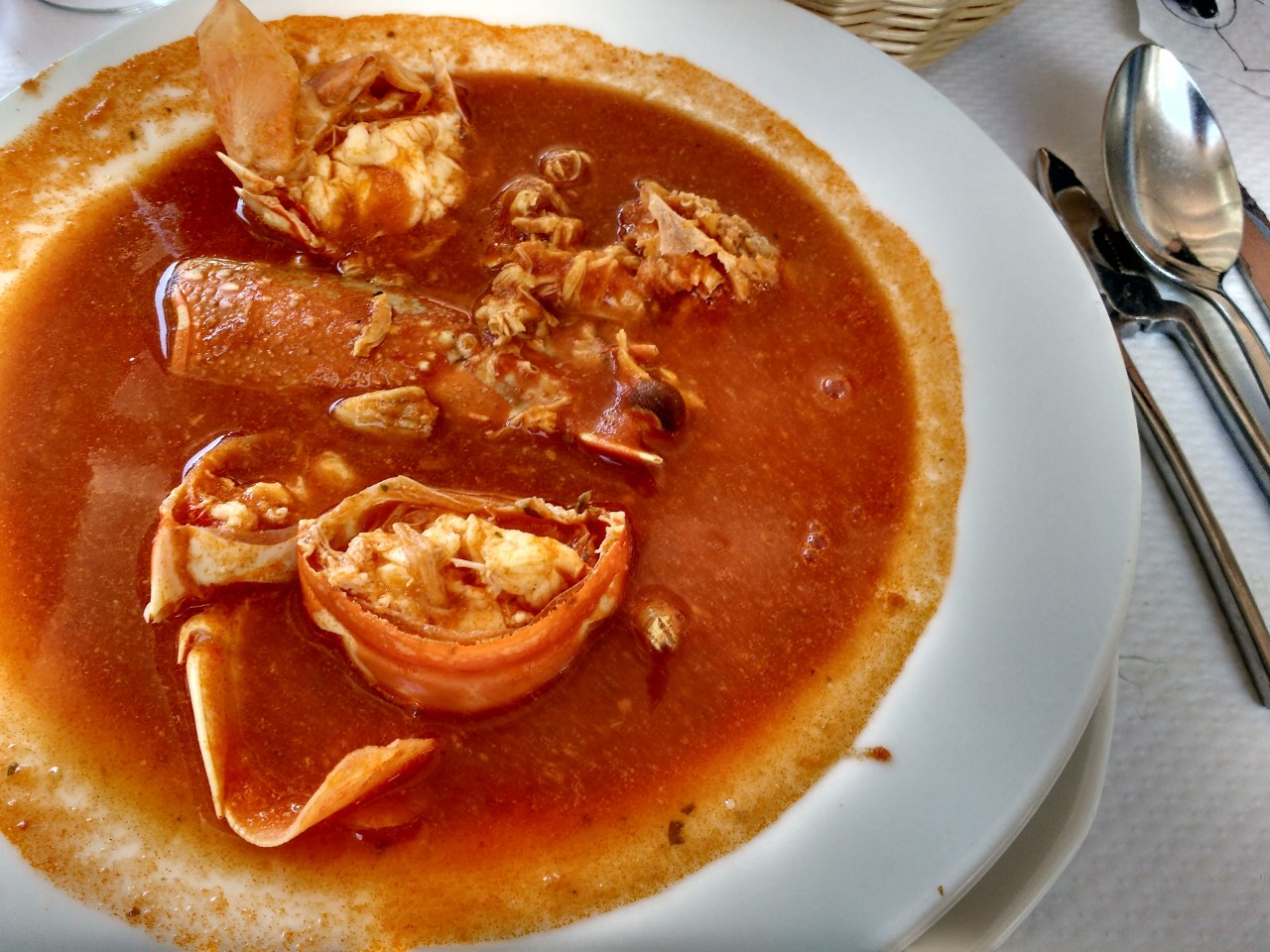
Without a doubt, the Caldereta de Langosta is one of the best-known dishes of Menorcan cuisine. The name comes from caldereta, the terracotta bowl the dish is still cooked in even today. It’s a lobster soup, preferably using lobsters that are female and not too young. In fact, the older the lobster, the better the broth. Along with the lobster, the dish also includes cherry tomatoes, onions, green chili, parsley sprigs and slices of bread.
Caldereta is not a dish to be eaten immediately: it tastes best 5 hours after it is made, and ideally should be cooked one day in advance. Although it can be enjoyed all over the island, the best place to eat it is said to be the fishing village of Fornells, where several restaurants boast it as their speciality.

Where to try caldereta de langosta in Menorca: among the many options in Fornells, I indicate the restaurant Sa Llagosta (Carrer de Gabriel Gelabert, 12, 07748 Fornells) facing the sea, by the well-known Chef David De Coca.

2. Typical Menorca dishes: Ensaimada

ensaimada minorca

Another typical Menorcan dish, ensaimada, has been part of the gastronomy of the Balearic Islands for centuries. It is an iconic dessert, and the most famous. Ensaimada is so beloved that it has its own Protected Geographical Indication, “Ensaïmada de Mallorca“.

Ensamaida is said to have Arab origins, and its characteristic shape, resembling a rolled turban, only serves to strengthen the argument. It is as easy to prepare as it is tasty.

Its main ingredients are flour, water, sugar, eggs, and lard, and is baked until it forms its characteristic shape. Sometimes they have icing sugar sprinkled on top and sometimes they have a filling. The traditional filling is cabell d’àngel, a sort of pumpkin jam, but it can also be filled with delicious custard. We have the feeling that once you’ve tasted it, you may well become addicted.

Where to try ensaimada in Menorca: if you want to try the best Ensaimada in Menorca then we recommend Can Pons (shop and workshop in Es Mercadal, Carrer del General Albertí, 6),winners of the Best Ensaimada award at the 2020 world championship.

3. Typical Menorca dishes: Oliaigua

A must-try Menorcan speciality is oliaigua, a humble recipe that farmers would use when enduring hardship. Mainly made of up water, oil, and some aromatic herbs, it was a typical breakfast. Over time, it has become the first course in many meals, adding vegetables to make a tasty soup of water, oil, tomatoes, green pepper, and garlic, served in a bowl with layer of toast on the bottom.

It’s always eaten at room temperature or warmed up a little bit. The recipe has so many variations that Menorcan restaurants often have their own version, adding different ingredients depending on the season.

Where to try oliaigua in Menorca: among all the restaurants visited, I suggest you try El Faro de Cala Torret (​​Carrer de ses Cranques, s/n, Binibequer Nou, 07711).

4. Typical Menorca dishes: Mahon cheese

formaggi mahon minorca

Another highlight belonging to the typical gastronomy of Menorca is queso de Mahon. Declared a PDO since 1985, this cheese is made with unpasteurised cow’s milk, generally Frisian breed, to which a small percentage of sheep’s milk is sometimes added.

Where to try Mahon cheese in Menorca: if you want to buy it and visit a farm in Menorca at the same time, I recommend La Subaida in Alaior (Carretera Alaior a Arenal de’n Castell s/n, 07740).

5. Typical Menorca dishes: Menorcan stuffed aubergine

A Menorcan speciality baked stuffed aubergine is a very common dish on the island, so popular that you will often find it in bars and restaurants. Local aubergines are used, which are smaller and more tender than regular ones.

To cook them, the aubergines are emptied and their pulp is removed to be used alone or mixed with other ingredients. They are then baked in the oven with chopped garlic, parsley and a sprinkling of breadcrumbs. Summertime is the best time to enjoy this delicious dish, as aubergine is in season.

Where to try stuffed eggplant in Menorca: at the La Guapa restaurant, in Fornells (Carrer Major, 29, 07748), you can try the typical cuisine of Menorca in a pleasant place with excellent service. Apart the eggplant, you can’t leave without trying the lobster. 

6. Typical Menorca dishes: Sobrasada

sobrasada menorca

Sobrasada is the most popular and most eaten sausage in Menorca. It’s made with selected pork meats, both lean cuts and bacon. The meat is stuffed and seasoned with salt, pepper and paprika, which gives it its characteristic red colour.

Spread onto a slice of bread, it is a delicious delicacy at any time of the day, although it can also be found in many traditional island recipes, such as the local rice.

Where to try the sobrasada in Menorca: at Es Tast de na Silvia (Carrer de Santa Clara, 14, 07760 Ciutadella de Menorca, Balearic Islands), a welcoming restaurant in the historic centre of Ciutadella, Slow Food certified.

7. Typical Menorca dishes: Arroz de la Tierra

Arroz de la Tierra is a risotto made with semolina and wheat. It’s a typical rural dish, made by soaking the rice all night.The following day, it’s placed in a terracotta bowl and left to cook with finely chopped bacon, sobrasada, butifarrón and sausages. Then potatoes are added. It’s a real treat.

Where to try arroz de la tierra in Menorca: at Mon Restaurante y Fonda, one of the best restaurants on the island, located in a renovated traditional house on the Paseo San Nicolás de Ciutadella.

8. Typical Menorca dishes: Fideuà

If you prefer pasta to rice, then Fideuá will win you over. Originating as an alternative dish to Paella, in order to cook it we use a type of short and thin pasta, similar to angel hair, which is mixed with chicken, shrimp, mussels or clams, fish broth, tomato, saffron and parsley.

Where to try Fideuá in Menorca: at Restaurant Sa Nacra (Carrer de Sa Nacra, Santandría – Sa Caleta, Ciutadella de Menorca) in Ciutadella, specialising in noodles and paella. The location with a terrace overlooking the sea is spectacular.

mercado pescado menorca

9. Typical Menorca dishes: Stuffed squid

Where to try stuffed squid in Menorca: at the Es Bruc beach bar, a stone’s throw from the sea. There are two: one on Santandria beach and one on San Adeodato beach, in the locality of Sant Tomàs.

10. Typical Menorca dishes: Pastissets

pastissets menorca

Pastissets are shortbread cookies in the shape of a flower with rounded tips. They can be plain, sprinkled with icing sugar or filled with fig jam. In the olden days, these cookies were made at Christmas time and during other holidays. Today, they can be found all year round in any bakery.

Where to try pastissets in Menorca: in Es Mercadal you can try them fromCas Sucrer, right in the centre.

Menorcan gastronomy is extremely rich and varied, and will satisfy everyone’s tastes. We recommend that you spend part of your holidays on the island enjoying these typical dishes and products: you will not regret it, and you will discover a very pleasant and tasty side of Menorca!

The island of Menorca is one of the most popular coastal destinations among tourists from all over the world, especially during the summer months, to enjoy its famously amazing beaches.

Summer, the best time to visit Menorca

Thanks to its excellent climate and high number of hours of sunshine per year, I can happily say that summer in Menorca starts at the end of May and goes on until the end of September. There are even those who go for a swim as late as November!

As well as enjoying the wonderful beaches of Menorca, in the summer you can admire its lush nature, with its fields full of flowers, not just in spring. You can stroll through the streets of the towns and villages, visit markets, prehistoric monuments and much, much more.

I hope I’ve convinced you. So let’s take a look at the TOP 10 things to see and do in Menorca in the summer!

TOP 10 things to see and do in Menorca in SUMMER

There are so many things to see and do in Menorca in the summer: the island shakes off the winter blues and offers its visitors all kinds of activities, for all tastes.

Shortening the list down to 10 things is no easy task, but I’ll do my best. Here are my TOP 10 things to see and do in Menorca in the summer:

1. Macarella e Macarelleta

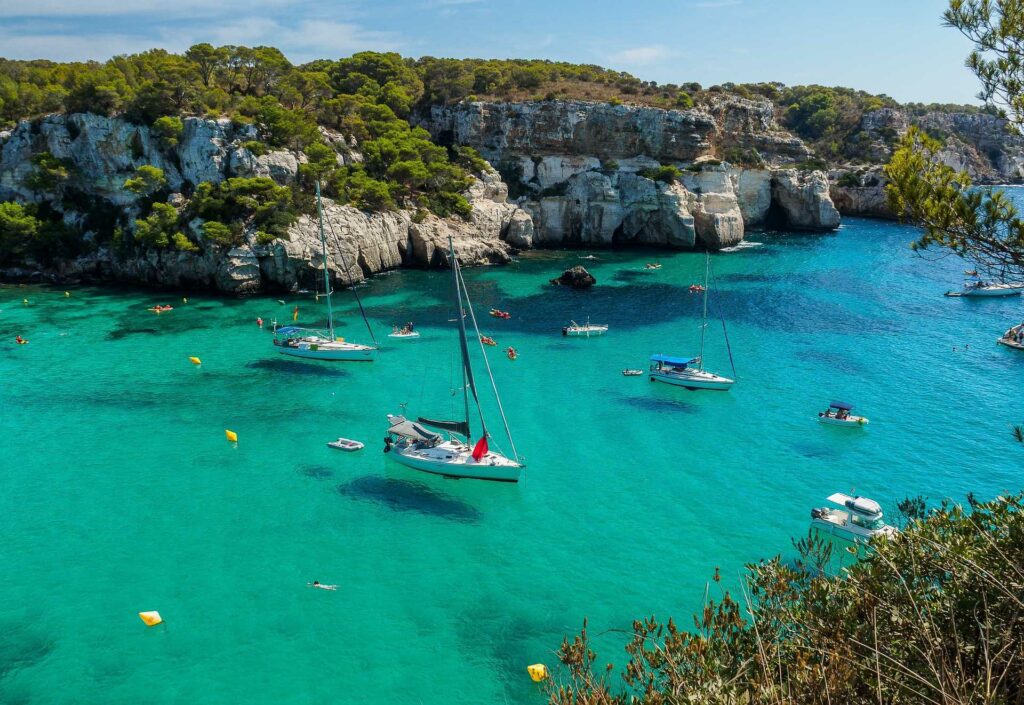
I’ll start with what, without doubt, is one of Menorca’s greatest claims to fame: the famous beaches of Cala Macarella and, its little sister, Cala Macarelleta.

These two stunning coves, in the south of Menorca, are among the most popular with tourists and locals, due to their unique beauty. The pure-white sand contrasting with the turquoise sea and the green pine forest surrounding the coves will truly take your breath away! From 1 June until 30 September you won’t be able to get to Cala Macarella in your own vehicle; you will need to take the public bus that goes from the centre of Ciutadella.

But my advice would be to park your car at Cala Galdana and then walk a stretch of the Camí de Cavalls, you won’t regret it!

Macarelleta can be reached by a short scenic walk from Macarella.

Get up early, though! Both beaches get very busy in the summer.

2. Mahón, the capital of Menorca

The city of Mahón should definitely feature on your Menorca to-do list.

My tip would be to wander aimlessly through the streets of its old town and, of course, visit its incredible harbour. The Port of Mahón, the second largest natural harbour in the world, has its own unique charm and is certainly worth a visit.

But I wouldn’t just limit yourself to strolling along the seafront, exploring the shops and having lunch or dinner in one of its many restaurants; you should also view the harbour from above: in the centre of Mahón you’ll find various viewpoints offering stunning views of the harbour.

porto di mahon menorca

3. Walking the Camí de Cavalls

The Camí de Cavalls is an ancient trail 185km long, running around the entire coast of Menorca.

If you’re not used to walking, don’t worry! There are short sections of the Camí de Cavalls that are suitable for almost any walker. But do make sure that you put on appropriate footwear (preferably closed in) and take water and suncream with you.

cami de cavalls

4. Cala Turqueta

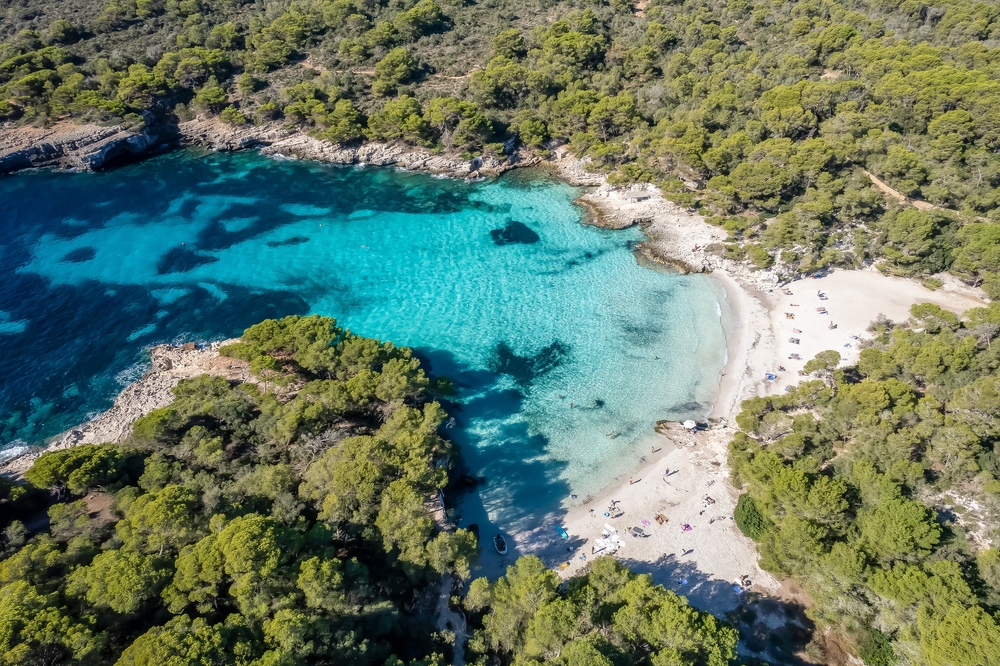
With its crystal-clear waters, lush vegetation and wild landscape, Cala Turqueta, in the south of Menorca, is a true paradise for sea lovers.

During the summer months, I’d advise you to visit this cove very early in the morning or late in the afternoon to avoid finding the carpark full.

cala turqueta menorca

5. Ciutadella

Ciutadella, the former capital of Menorca, has a charm that very few cities can boast.

I’d recommend you stroll aimlessly through the streets of its centre, losing yourself among the city’s historical buildings. It will be like going back in time!

ciutadella

6. Cala Pregonda

Cala Pregonda is, to my mind, the jewel of the north coast of Menorca. You can only reach it on foot, after walking for 40 minutes or so, and you’ll feel like you’ve landed on another planet.

Its reddish sand and the islets protecting the bay from the waves make it truly unique.

There are no amenities close by at Cala Pregonda, so take with you everything you need for a lovely day on the beach.

cala pregonda

7. FORNELLS

The village of Fornells, in the north of Menorca, is famous for its restaurants serving traditional cuisine. It is, in fact, the best place for trying the famous Caldereta de Langosta, or lobster stew.

But Fornells is not only somewhere with excellent food; it’s a quiet fishing village where you can take some wonderful walks around its harbour and truly soak up the culture and traditions of Menorca.

FORNELLS MINORCA

8. Cova d’En Xoroi: landscapes and legends of Menorca

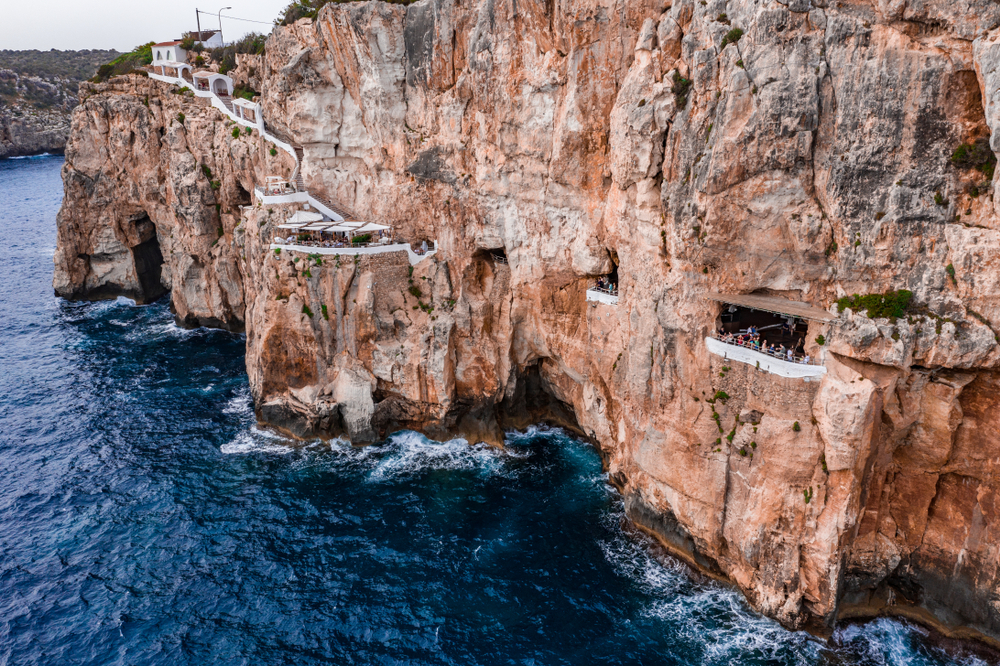
The island of Menorca is steeped in legend, but the most famous is probably the one surrounding the cliff-side cave, Cova d’En Xoroi.

This legend tells us that the pirate Xoroi, after his ship was wrecked, settled on the island of Menorca, stealing food and livestock from the farmers who lived there. Then one day, a girl from Alaior disappeared. They kept looking for her for a long time, but never managed to discover her whereabouts, until one day it snowed in Menorca!

The inhabitants followed some strange footprints, which led them to Xoroi, along with the missing girl and their two children, the fruits of their love.

Xoroi and his eldest child threw themselves into the sea to escape and were never seen or heard of again!

Nowadays, the Cova d’En Xoroi houses a nightclub with beautiful sea views. The ideal place for watching the sun go down in Menorca!

COVA D'EN XOROI

9. Cala Morell

Cala Morell, together with its necropolis, makes for a very interesting visit on the island.

It’s not the typical white sandy beach, of course, so characteristic of the island, but a small beach surrounded by an ancient necropolis from the Talaiotic Period. There are in fact 17 artificial caves dug out of the rock, where experts have found clues to how their inhabitants may have lived over 3,000 years ago.

You can also snorkel here and explore some beautiful underwater caves full of the marine plants and animals of Menorca.

Sipping on a sundowner at one of the lovely bars with a view is definitely an experience you’ll want to enjoy in Menorca!

VISTA CALA MORELL DESDE NECROPOLIS

10. Son Bou

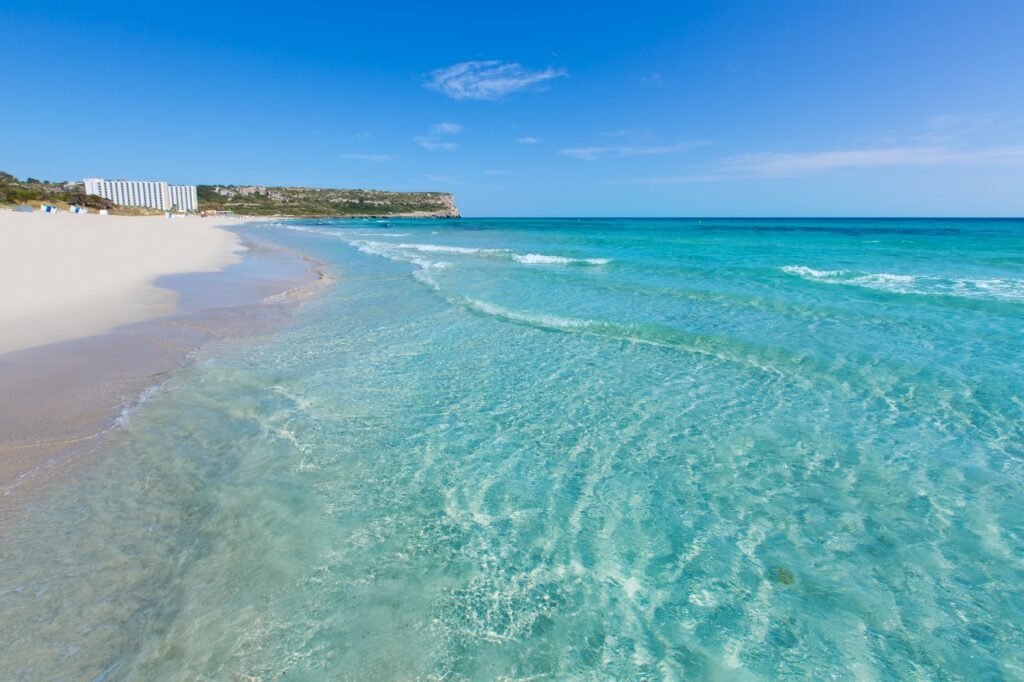
Son Bou is the ultimate family-friendly beach, but not only that, it’s also Menorca’s longest. Stretching along the south coast of the island, it’s ideal for spending a day on the beach with all facilities and services to hand.

Here you can relax on the sunbeds for hire or enjoy the water sports. There’s something for everyone here!

SON BOU MINORCA

Minorca è un’isola che ha davvero molto da offrire ai suoi visitatori, per questo motivo, questa lista potrebbe essere infinita. E tu, conosci Minorca? Qual’è il tuo TOP 10?

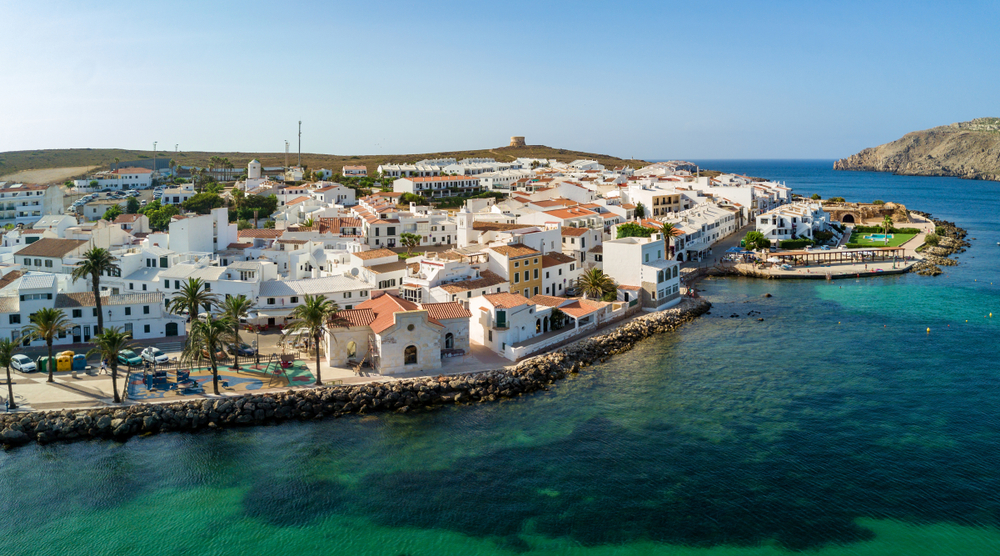
A typical Mediterranean village, Fornells is one of those charming places that, in spite of the arrival of tourism, which undoubtedly benefits the village, has managed to retain its essence and conveys this to its visitors. A real journey through time and an absolute must during your visit to Menorca!

Fornells, a coastal village

The village of Fornells, with around just 1,000 inhabitants, lies on the north coast of Menorca and in ancient times was a very important place on the island, providing a safe haven for fishermen in its natural bay stretching more than 3 km. 

fornells menorca

It was also a strategic point of defence on the island against pirate raids. In fact, today you can still see the remains of castles (the Castle of San Antonio) and defensive towers around Fornells.

Read on and we’ll tell you about the best things to see and do in Fornells.

How to get to Fornells

How to get to Fornells by car

Fornells, as we said earlier, is on the north coast of Menorca. Getting there by car from Mahón is very easy as you just need to take the Me-7, the road that connects the two, a drive of around 20 minutes.

From Ciutadella, on the other hand, it’s a slightly longer drive and you need to take the Me-1 as far as Es Mercadal and from there continue along the Me-15 until you reach Fornells.

To get to Fornells from the airport, drive in the direction of Mahón and from there take the Me-7. It will take around half an hour to reach your destination.

How to get to Fornells by bus

If you don’t have your own vehicle, it’s still easy to get to Fornells using Menorca’s public transport network, although you will need to change buses.

From Mahón, take the no.1 bus as far as Es Mercadal and from there the no.45 to Fornells.

From Ciutadella, you can use the same bus routes, but this time in the opposite direction.

To get to Fornells by bus from the airport you first need to take the shuttle bus from the airport to Mahón bus station and from there bus nos. 1 and 45 again.

The best beaches around Fornells

In the vicinity of Fornells, you’ll find some beautiful beaches. Just outside the village (around 6.5 km) is Cala Tirant, a semi-urban beach ideal for taking a dip when visiting the village and the surrounding area.

cala tirant menorca
Cala Tirant

If, on the other hand, you’re looking for an unspoiled beach, typical of the rugged landscape of the north of Menorca, not far from Fornells you’ll find Cala Cavalleria, with its red sand and the beautiful lighthouse watching over it.

A bit further away, but definitely worth a visit, is Cala Pregonda, the pearl of the north of Menorca.

Trips in Fornells

With its vast bay stretching more than 3 km, Fornells forms part of the Marine Reserve of Menorca, making it the ideal place for water sports.

Windsurfing, sailing and, of course, snorkelling are some of the activities to be enjoyed in Fornells.

You can also hire a boat in the village to explore the beautiful north coast of Menorca at your leisure or, if you’d rather not take the helm, you can book yourself a trip on a boat, catamaran or sailboat.

excursion barco fornells

Traditional cuisine in Fornells

You can find some of Menorca’s traditional dishes in Fornells. There are some renowned restaurants here, offering you local delicacies to try.

Among the most notable are Es Cranc and Sa Llagosta, a restaurant that combines traditional flavours with a few innovative touches. Here you’ll find various dishes featuring lobster as the key ingredient.

Other things to do in and around Fornells

Fornells is not a very large village, but it certainly has lots to offer its visitors. Let’s take a look at what you can’t afford to miss in Fornells:

  • Fornells Harbour: the most interesting part of the village is definitely its beautiful harbour, with its pretty promenade lined with shops, restaurants and bars.
puerto de fornells
  • Castle of Sant Antoni: an ancient defensive castle which has been completely restored and is free to visit. We especially recommend the views from this enclave; they’re stunning!
  • Fornells Tower: an ancient defensive tower built when Menorca was under British rule. It’s the highest tower on the island and an excellent vantage point for views of the north coast.
  • Church of San Antonio Abad: this little church stands in the historical centre of Fornells and is free to visit.
iglesia san antonio abad fornells
  • Ses Salines de Fornells: situated at the end of the bay of Fornells, Ses Salines is a seaside resort with its own beach and a wide range of accommodation and restaurants.

Finally, just a 20-minute drive or so from Fornells is the Cap de Cavalleria Lighthouse, one of the prettiest and most popular lighthouses on Menorca.

Fornells is a charming little coastal village in the north of Menorca, offering its visitors a peaceful and relaxing stay, but also, if you like, plenty of activities and attractions, not to mention its excellent cuisine!

SHALL WE INSPIRE YOUR NEXT TRIP?