archive.php

Greece is certainly one of the places where we would all like to go at least once in a lifetime, both to discover Athens and to enjoy the beauty of the Aegean islands

Athens, the cradle of civilization, the center of culture and classical art, philosophy, mythological and heroes’ stories and now the economic and political center, preserves countless stories, riches and precious activities to be discovered.

Between a visit to the Acropolis, a walk in Monastiraki and an aperitif on the beach, this city really has a particular charm.

In addition to Athens, Greek islands also represent a heritage for the beauty of the sea, landscapes and people. Crete, Mykonos, Santorini among the best known, followed by Kos, Kalamata, Skiathos and many others offer wonderful sights scenarios.

In a nutshell: to be amazed!

To find out more about Athens and the Greek islands below we recommend a series of readings and films that can serve as a source of inspiration.

1. FILMS

My Life in Ruins


Review

Directed by Donald Petrie (“Miss Congeniality,” “Grumpy Old Men”) from a screenplay by Mike Reiss that is larded with stale 1970s-style sitcom humor, “My Life in Ruins” has none of the homey authenticity of “My Big Fat Greek Wedding” (which Ms. Vardalos wrote). Seven years after her breakthrough, Ms. Vardalos may be slimmer and more glamorous, but she seems less real. Her character is an aspiring professor who, desperate for work, has taken a job as a guide for a second-rate touring outfit that buses visitors to the Parthenon and other ancient sites.

“Georgia (Nia Vardalos) came to Greece to follow a man. A few years later, she’s been cast aside — alone and adrift in a foreign land. Eventually, her passion for history leads her to a job as a tour guide. But Georgia is bored, and has lost her “kefi” (Greek for mojo) to boot. When taciturn sasquatch Poupi (Alexis Georgoulis) replaces the regular driver at the last minute, the frazzled tour guide thinks that her luck has just hit rock bottom. Thankfully, Georgia’s latest batch of tourists is a more lively bunch than she’s anticipated, and in between bouts with rival tour guide Nico (Alistair McGowan), she manages to form a genuine connection with wisecracking widower Irv (Richard Dreyfuss), a solo vacationer who maintains a jovial facade despite the fact that he misses his late wife dearly. With a little help from Irv, Georgia comes to realize that true love may be closer than she thinks — if she could just recapture her kefi and open her eyes.”

~ Jason Buchanan, Rovi – Rottentomatoes.com

Mediterraneo

Review

Gabriele Salvatores’s “Mediterraneo” is a deliberately charming comedy whose most daring conceit is that love, in one form and another, makes the world go around. Actually, it’s somewhat better than it sounds, having the good sense not to slop over into the sentimentality that awaits it at every turn. Mediterraneo was nominated in 1992 for the Oscars as best foreign language film.

The time is 1941, a year after Italy joined Germany in the war against the Allies. A small group of undisciplined Italian soldiers is dispatched to a tiny Greek island in the Aegean for four months of lookout duty. They include a young lieutenant with a passion for art, a robust sergeant who is the font of all Army knowledge, a former farmer accompanied by his beloved donkey, and other particular types.

For a while the soldiers live in edgy expectation of unforeseen calamity. There is a village on the island but no sign of people. One night they see a terrible explosion on the horizon and realize that their relief ship has been torpedoed. As if that weren’t enough, the owner of the donkey goes temporarily mad when the animal is shot by accident. In a tantrum of grief the soldier destroys the group’s radio. The men lose all touch with the world outside.

2. NOVELS

Corfu Trilogy


Review

The Corfu Trilogy consists of the popular classic “My Family and Other Animals” and its delightful sequels, “Birds, Beasts and Relatives” and” The Garden of the Gods”. All three books are set on the enchanted island of Corfu in the 1930s, and tell the story of the eccentric English family who moved there. For Gerald, the budding zoologist, Corfu was a natural paradise, teeming with strange birds and beasts that he could collect, watch and care for. But life was not without its problems – his family often objected to his animal-collecting activities, especially when the beasts wound up in the villa or – even worse – the fridge. With hilarious yet endearing portraits of his family and their many unusual hangers-on, The Corfu Trilogy also captures the beginnings of the author’s lifelong love of animals. Recounted with immense humour and charm, this wonderful account of Corfu’s natural history reveals a rare, magical childhood.

The Greek Persuasion


Review

Consumed by a myth about Zeus, a magic sword, and soul mates, Greek-American professor Thair Mylopoulos-Wright has spent much of her life searching for her Other Half. At thirty-one, she spends a summer in Greece; there, alone on a tranquil island, she begins writing stories about her grandmother’s experiences in 1940s Egypt, her mother’s youth in 1960s Greece, and finally, her own life in contemporary America—trying to make sense of her future by exploring the past.

Spanning Thair’s life from thirty-one to thirty-six, The Greek Persuasion explores human sexuality, the complexity of mother-daughter relationships, and the choices women of different generations make when choosing—or settling—for “Mr. (or Ms.) Good Enough.” Will Thair ever find that missing part of her that Zeus chopped off with his magic sword? Or is the concept of The One just one big fairy tale that has left her searching for someone who doesn’t exist?
3. MUSIC

PLAYLIST OF GREEK ISLANDS

Corfu isn’t just stunning beaches and resorts, oh no! Fancy strolling through the town and finding out a little more about the cultural heritage of this magnificent island?  Here are a few recommendations for sightseeing around Corfu Town and the surrounding areas.

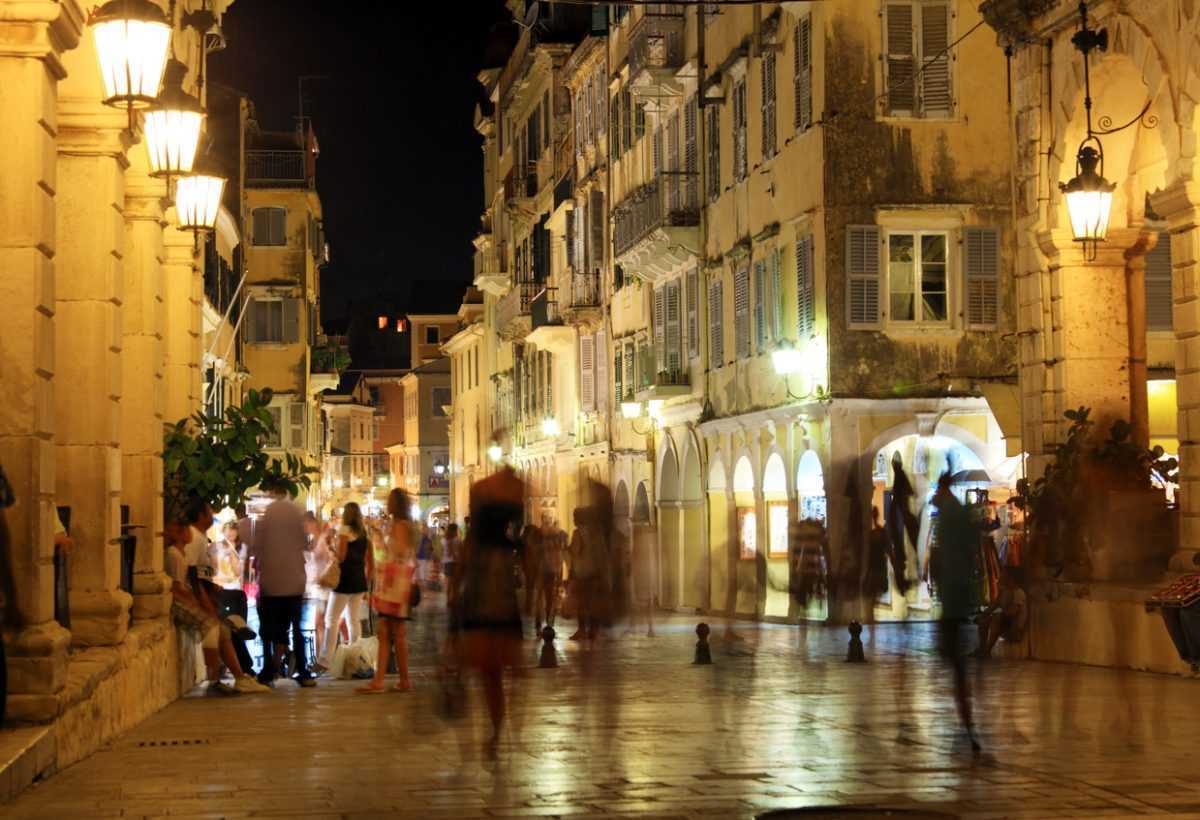
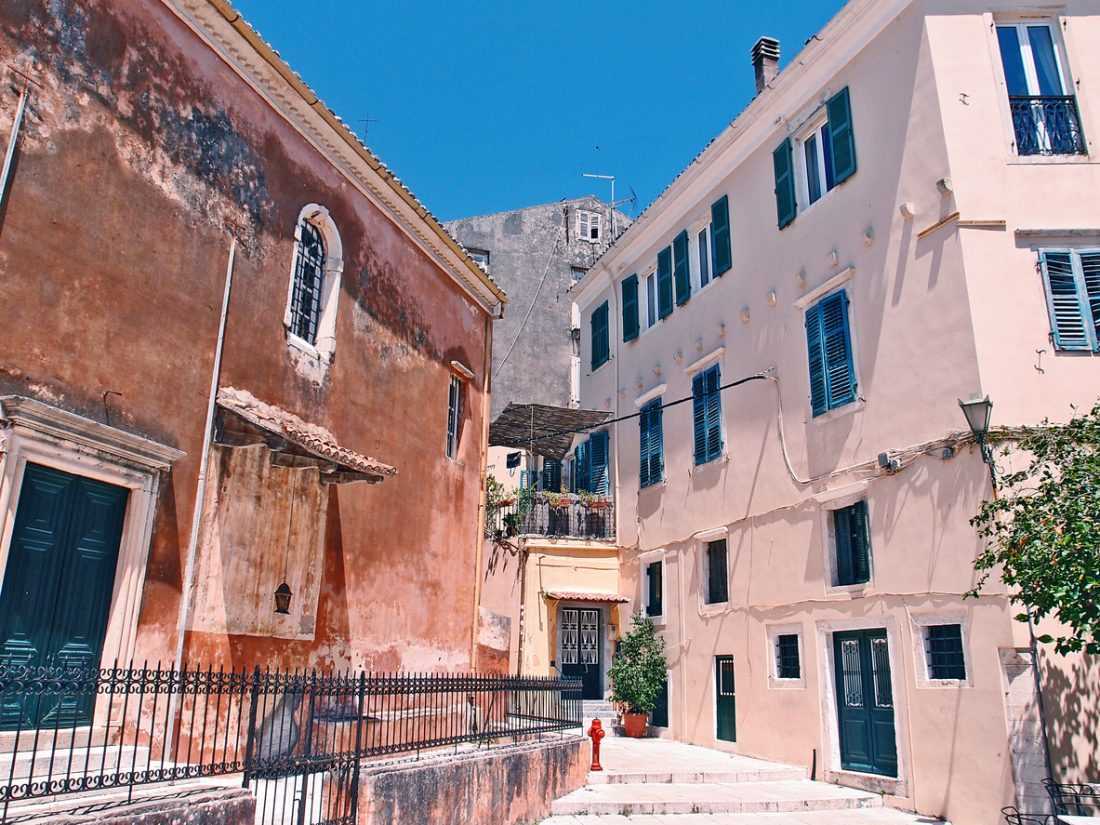
With almost 30,000 residents, Corfu Town is home to a third of the population of the regional unit of Corfu (Corfu, Paxoi, Antipaxoi, Othonoi, Ereikoussa and Mathraki). It’s divided into the old town (Xopoli, between the old and new citadels) and three modern suburbs: Mantouki to the north-west, Saroko between the hills of Avrami and Sotiros, and Garitsa, which begins at the Douglas Column to the south. The historic centre is in the old town, the ramparts of which have prevented it from spreading, resulting in its unique architecture, with tall houses rising up over several floors, narrow alleyways (kantounia) where the locals hang their laundry out to dry, and little squares. It is the largest preserved medieval town in Greece and one of the most beautiful in the Mediterranean, being listed as a UNESCO World Heritage Site since 2007.

Here’s a small selection of places not to be missed, if you decide to explore Corfu in more detail:

  The Spianada (Esplanade). The town’s central square, one of the largest and most impressive in the country. It was designed in the 17th and 18th centuries, when, as part of fortification work to protect the city, the Venetians opened the “Spianata” – occupying an area that at that point took up a third of the town- in front of the old citadel, so as to create a large firing range for defenders in the event of attack. It’s the most popular promenade for locals and visitors, and it’s here that most events take place, such as concerts, processions, parades, and cricket matches (on the lawn). Opposite is the Pentophanaro, ideal for skateboarding, the monument of the Union of the Heptanese, the Venetian Cistern and the bandstand where orchestras give concerts.

  The Liston, one of the most famous features of the Spianada, with its instantly recognisable arches. It was built by a French engineer, Lesseps, during the French Empire’s administration of the island and modelled on the Rue de Rivoli in Paris. A series of bakeries, coffee shops and boutiques give it a cosmopolitan look and make it a meeting place.

•  The palace of St. Michael and St. George, a large Georgian building built between 1819 and 1823. This richly decorated palace, with its magnificent gateways and a Doric colonnade, served as a seat for the English delegates of the Ionian Senate and the order of St. Michael and St. George. It now houses the sizeable Museum of Asian Art, which has around 10,500 pieces of art from India, China, Korea, Pakistan, Japan, and more (coming from private donations), as well as the Municipal Art Gallery, which mainly exhibits works by nineteenth- and twentieth-century Corfu artists.

•  The Reading Society, the oldest intellectual institution in modern Greece.

•  The gate of Agios Nikolaos (Saint Nicholas). Opposite the Reading Society, below the main road, lies the small bay of Faliraki and the Corfu’s famous – formerly private – beach, “Alekos baths”.

•  Mouragia, one of the most beautiful parts of town. There, take Arseniou Street, which starts at the old port and ends at the palace of St Michael and St George, in the central square. In this district (1 Arseniou Street) you’ll find the Dionysios Solomos Museum in the house where the poet and author of the “Hymn to Liberty”, the words of which became the Greek national anthem, lived for around thirty years until his death in 1857.

•  The Old Citadel, built on a peninsula near the Spianada. For defensive reasons, the Contra Fossa moat was dug to turn the peninsula into an island. The fortification begun by the Byzantines was continued by the Venetians. It is linked to the city by an impressive bridge. The citadel’s most important monuments are the central gate, the bastions of Savorgnan, Martinego and Mandraki, the towers of the land and the sea, Agios Georgios church (1840), a basilica modelled on an ancient Doric temple, a Catholic chapel, the old prisons, the English barracks and the English hospital. You can also see the lighthouse, the clock tower, the Municipal Central Library and the Historical Archives.

•  Campiello, the oldest district of Corfu, with the Panagia Kremasti church and a square with a Venetian well.

•  Kanoni, one of the most touristy places in Corfu, with a splendid view of the Vlacherna Monastery, Pontikonisi, the Chalikiopoulou Lagoon and the airport.

•  Pontikonisi, a small island that has become the symbol of Corfu and which, according to mythology, is a fossilised Phaeacian ship.

•  Mon Repos (3km to the south). A visit to this splendid estate is essential. The neoclassical building was the summer residence of the former Greek royal family. The villa, originally built to house the English Commissioner Sir Frederick Adam and his wife, Diamantina Palatianou, a Corfu local, is a masterpiece of 19th century neoclassical architecture. The small yet interesting Archaeological Museum of Palaiopolis can be found there.

•  Palaiopolis, an archaeological site near Mon Repos. This is the agora of ancient Kerkyra (Corfu). It’s worth seeing the Temple of Apollo (in Mon Repos, near the ruins of the Temple of Hera), the Roman baths, the agora and a construction from the end of the Hellenistic period.

One thing is certain, if you’ve had enough of boat trips, water sports, white sandy beaches and turquoise water… Corfu can also offer you vast cultural heritage to be discovered on beautiful strolls.

Cosmopolitan Corfu is perhaps the most famous of the Ionian Islands and one of the best loved islands isles throughout the Mediterranean. It spans 591km² and boasts 217km of coastline. A magnet for hundreds of thousands of visitors each year, as well as a source of inspiration for all the arts, and rich in cultural heritage, its special prestige combines with its natural beauty, pleasant climate, beaches and fascinating sights to make it one of the most attractive destinations for Greek and foreign tourists alike.


SHALL WE INSPIRE YOUR NEXT TRIP?