In addition to the beaches, towns and hiking trails, giving the nuraghi their own itinerary during your stay is a great way to learn about Sardinia and its history. These structures are easy to spot as you drive along any road on the island, but we want to highlight those that we think are worth visiting because they’re the best preserved, most beautiful and interesting to see.
Nuraghi in Sardinia: what are they?
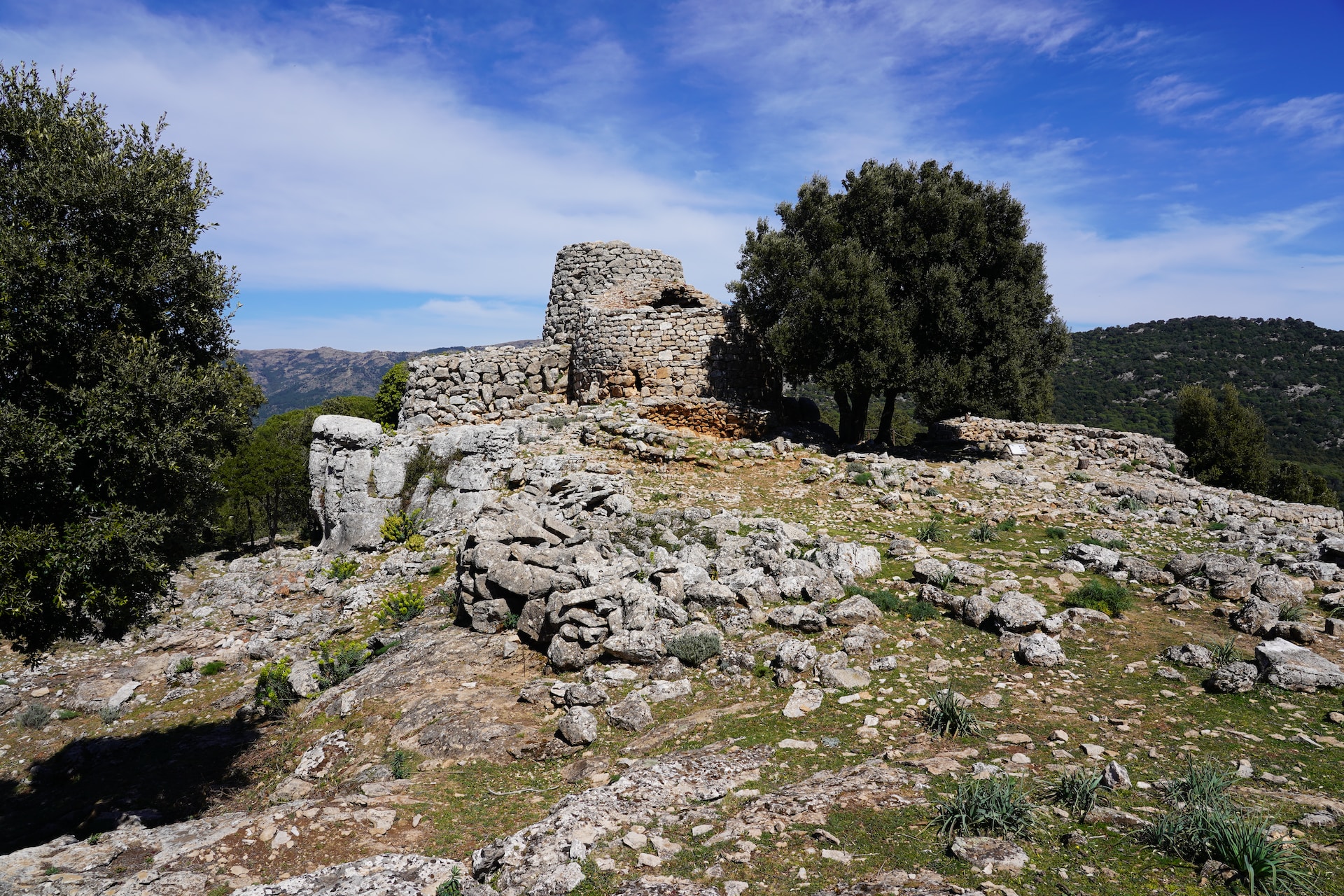
Nuraghi are ancient megalithic stone structures unique to Sardinia that date back to the 2nd millennium B.C. They remind you of medieval castles, with their bastions and walls, but with a circular shape.

Nuraghi: who built them?
Archaeology relies on indirect evidence obtained from studying excavations and from finding materials and ovens; that’s why, sadly, there are no written sources and today there are still so many mysteries surrounding the world of the ancient Sardinians. So to answer the question ‘who built the nuraghe?’ we can only tell you that it was the Nuragic people, a prehistoric civilisation that emerged and expanded throughout Sardinia during the Middle and Late Bronze Age and the Iron Age (circa 1700-700 B.C.), and whose name has become synonymous with the structures they most commonly built.
Why did the Sardinians build the nuraghi out of stone?
The main objective of any people, the Nuragic civilisation included, was to take possession of land and to then give it their own legacy. However, the purpose of the nuraghi is not altogether clear. All we know is that at some point in history they were places of worship for the inhabitants of the village.

What we do know, though, is that the nuraghi were subsequently used for other purposes over the course of their existence. But the real question is: how were they built, and above all, in how many years? Well, we’re sorry to disappoint you, but unfortunately nobody knows. How the blocks of basalt were transported and erected remains a mystery to this day.
How many nuraghi are there in Sardinia?
The nuraghi are a characteristic feature of Sardinia’s rural landscape: there are around 7,000 of them scattered all over the island. Some are buried under mud while others were destroyed many years ago. Here’s a list of the most interesting ones to visit.
The most beautiful nuraghi in Sardinia
Nuraghe Losa in Abbasanta
SS 131 Carlo Felice, 09071 Abbasanta OR
The Nuraghe Losa in Abbasanta is the one that has delighted us most, maybe because of its unusual shape and because it’s one of the best preserved on the island. The nuraghe Losa, also known as “su nurache ‘e sas losas”, owes its name to the cinerary urns from Roman times that were found outside the village, not far from the boundary wall. Another curiosity is that the village was still in use in the Middle Ages!

The first thing you notice on the guided tour are the shelves on the ground, which were originally positioned at the top of the terrace of the nuraghe. There are actually some steps inside to take you up, treating you to an amazing view of the line of the outer wall.
We also discovered that the nuraghe is still inhabited – by bats, spiders, jackdaws and masses of lizards. Our advice would be to visit during solstice.
Here’s all the useful info:
- Guided tour (optional) runs from 9am until one hour before sunset.
- The full ticket costs €6.
- Dogs are also allowed, on the leash.
Nuraghe Arrubiu in Orroli
Località Su Pranu, 09061 Orroli SU
The nuraghe Arrubiu in Orroli is of course one of the most beautiful and interesting to visit simply because it’s the largest in Sardinia. It’s known as the red giant due to its structure, with its various shades of red basalt and the lichen colouring the surfaces of its walls.

Arrubiu is made up of 22 towers. The entrance faces southeast, opposite the direction the mistral blows, thus protecting the inhabitants from the wind. We know that after it was abandoned by its creators, around the 9th century B.C., it was repopulated in the 2nd century B.C. by the Romans, who adapted it to their needs.
- The entry ticket costs €5 and includes a guided tour.
- It’s open every day from 9:30am until dusk.
The Nuraghe Piscu in Suelli
SS 128 Centrale Sarda, 09040 Suelli Provincia di Cagliari
The nuraghe Piscu stands on a small hill in the countryside of Suelli, from where you can enjoy stunning views. We’ve feasted our eyes on such beauty for two reasons: the nuraghe is surrounded by green valleys and rolling pastures that are bursting with all the colours of the rainbow come spring, and walking around the defensive walls and inside the various rooms is a wonderful experience.
There is even a well! Although the nuraghe Piscu is unguarded and therefore free to enter, in our opinion, it is quite well preserved.

Nuraghe su Nuraxi in Barumini
Viale Su Nuraxi, 09021 Barumini SU
You can’t leave Sardinia without visiting the Nuraghe Su Nuraxi in Barumini, a UNESCO World Heritage Site. This Nuragic complex consists of a vast village of huts; its maze of narrow paths and cisterns is quite unique.
- It’s open every day from 9am until 4pm during the winter and until 7pm during the summer and can only be visited accompanied by a guide.
- The entry fee is €15 and the ticket also includes entry to the Zapata Museum and the Giovanni Lilliu Centre.
- The guided tours depart every 30 minutes and last around 1 hour.
Nuraghe Genna Maria in Villanovaforru
The Nuraghe Genna Maria stands on a hill 1km from Villanovaforru. We are now in central-south Sardinia, immersed in a tree-filled park steeped in the fragrances of the Mediterranean shrubland. There was a village both within and outside of the nuraghe that emerged around 1000 B.C. and was constructed in the same stone as the nuraghe.
The “inhabitants” fled due to a fire, never to return, leaving their possessions unattended until the “conquest” of the Romans, who repurposed the nuraghe as a sanctuary. The excavations revealed many finds, such as cooking pots, grindstones and even animal bones. We were amazed by the discs used for cooking dough and a well that functioned as a fridge.

The uniqueness of the nuraghe Genna Maria lies in its location being around 400 metres above sea level: from here, you can see 53 Sardinian towns and villages and, in really good weather, you can even see the Gulf of Angels in Cagliari. You can even see the Gulf of Oristano stretching out as far as the Giara di Gesturi plateau and the Gennargentu massif.
- Guided tours: every hour from 10am to 12pm and from 4pm to 6pm.
- Entry fee: full €4, reduced €3. For further information, take a look at the official website.
The nuraghe di Santa Cristina in Paulilatino
Località Santa Cristina, 09070 Paulilatino OR
The sacred well of Santa Cristina is the most mysterious place in Sardinia. It is situated near Paulilatino within an archaeological park, and there is also a beautiful nuraghe that we recommend you visit at sunset.
- It’s open all year round from 8:30am until dusk.
- Tickets can be purchased directly at the ticket office for €5.
Incidentally, you can also add to your list the nuraghe and Church of Santa Sabina in Silanus, the nuraghe Santu Antine in Torralba, the Nuragic complex of Palmavera in Alghero, the nuraghe Noddule and the nuraghe Dronnoro. Where would you start? Let us know in the comments. See you soon!