Discover the gems of Catalan modernism that you don’t see so often on the postcards, but which will capture your heart.
Barcelona: much more than the beach and tapas
Barcelona is a city to be experienced through the five senses. It has the sea and the mountains, vermouths in the sun, a passion for football and streets straight out of a fairytale. But if there’s one thing that gives it character and colour, it’s modernism. And no, we’re not just talking about Gaudí.
Although Antoni Gaudí is the most famous face of Catalan modernism, Barcelona is dotted with works by other geniuses who also left their mark on the city. Do you want to find out more?
What is Catalan modernism?
Catalan modernism was a cultural and artistic movement that flourished between the late 19th century and the early 20th century. Inspired by European trends such as Art Nouveau, it was searching for a truly Catalan identity, combining traditional elements and modern techniques. In architecture, this was expressed in undulating façades, colourful mosaics, wrought iron and an obsession with detail. Gaudí was its most iconic exponent, but he was not alone: Domènech i Montaner and Puig i Cadafalch also left their mark on the city.

1. Hospital de Sant Pau: modernism in citadel form
Location: Carrer de Sant Antoni Maria Claret, 167
How to get there: Metro L5 (Sant Pau | Dos de Maig)

This complex of pavilions connected by underground tunnels is the masterpiece of Domènech i Montaner. A fully functioning hospital until 2009, it is now a museum that takes you back to a different era.
2. Casa Amatller: the discreet neighbour of Casa Batlló
Location: Passeig de Gràcia, 41
How to get there: Metro L3 (Passeig de Gràcia)

Designed by Puig i Cadafalch, this house seems to have stepped out of a Flemish fairytale. Its staggered façade and ceramic details make it unique. Although it’s right next to the famous Casa Batlló, many tourists pass it by, but don’t make that mistake yourself.
An interesting fact: inside the Casa Amatller is a chocolate shop following in the tradition of the Amatller family, pioneers of chocolate in Spain.
3. Casa de les Punxes: a castle in the heart of the city
Location: Avinguda Diagonal, 420
How to get there: Metro L5 (Verdaguer)

Also the work of Puig i Cadafalch, this house looks like a medieval castle with its sharp-pointed towers. It was built for the Terradas sisters and each tower represents one of them.
Insider tip: after admiring the house, take a stroll through the nearby Gracia district, which is lively and picturesque.
4. Casa Vicens: Gaudí’s colourful debut
Location: Carrer de les Carolines, 20-26
How to get there: Metro L3 (Fontana)
Casa Vicens was Gaudí’s first great work and is a feast for the eyes. With oriental and Moorish influences, its green and red tiles make it unmistakeable.

An interesting fact: It was originally a summer house for the Vicens family, which explains its cheerful and relaxed feel.
5. Torre Bellesguard: Gaudí’s forgotten fortress
Location: Carrer de Bellesguard, 16-20
How to get there: FGC L7 (Av. Tibidabo) + bus 196
Inspired by an ancient medieval castle, this work by Gaudí combines history and modernism. Not as well known as his other works, it offers a more intimate and peaceful experience.
Insider tip: Take the opportunity to visit the nearby Tamarita Gardens, a haven of green, perfect for a picnic.
6. Casa Comalat: the wild imagination of Pupurull
Location: Carrer de Còrsega, 316
How to get there: Metro L5 (Diagonal)
The work of Salvador Valeri i Purpurull, this house is an example of unbridled creativity. Its less familiar rear façade is an explosion of colour and curved forms.
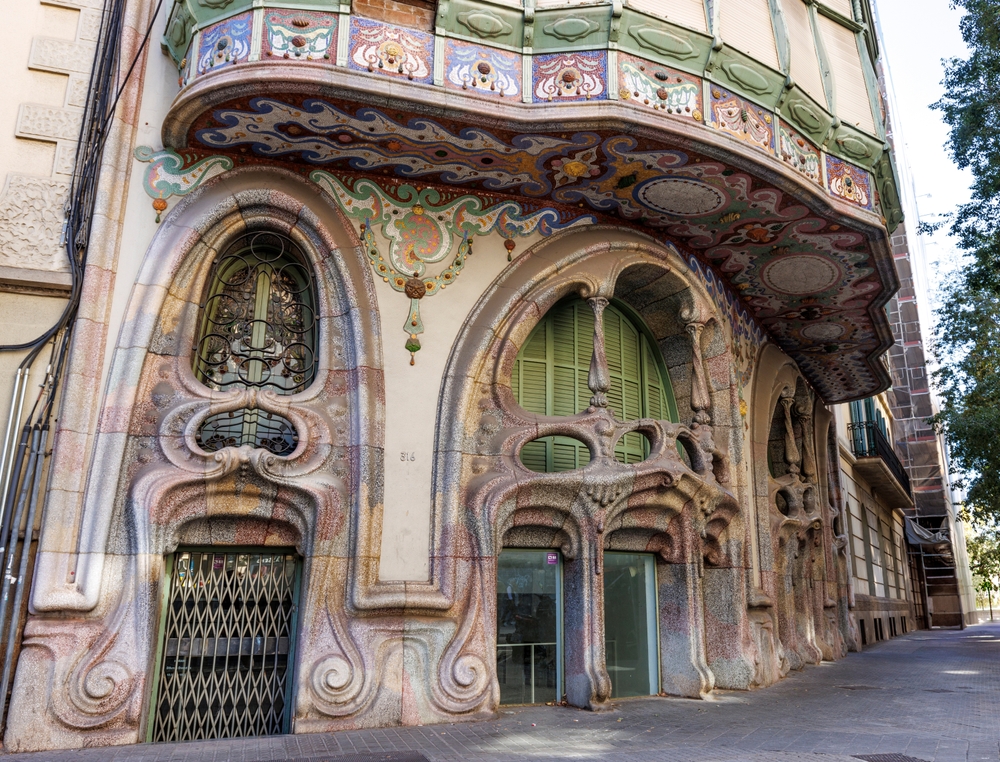
An interesting fact: The main façade and rear façade look as if they belong to two different buildings; make sure you see both!
7. Casa Planells: modernism in miniature
Location: Avinguda Diagonal, 332
How to get there: Metro L5 (Sagrada Família)
Designed by Josep Maria Jujol, this little corner house shows how modernism can also be compact and functional without compromising on beauty. Built between 1923 and 1924, it’s considered to be the last building of the modernist age in Barcelona.
Insider tip: Once you’ve admired it, take a walk around the nearby district of Sagrada Família and gaze at this impressive church, Gaudì’s masterpiece, from different angles.
Tips for a sustainable modernist tour
- Respect the environment: Many of these buildings are in residential areas. Keep the noise down and don’t block entrances.
- Support local businesses: Take a break in the cafés and visit the local shops. Your responsible consumption helps to keep the community alive.
- Avoid peak times: Visit in the morning or late afternoon for a more peaceful and enjoyable experience.
- Public transport: Barcelona has an excellent network of metro trains and buses. Use it to reduce your carbon footprint.

Barcelona is an open-air museum of Catalan modernism. Beyond the more famous works are countless gems waiting to be discovered. So next time you’re walking through the city, look up and delight in the art adorning its streets. Enjoy your trip!