Venice, a city suspended between dream and reality, has long captivated artists and writers. Its mysterious canals, its ancient palaces and its romantic air have made it an ideal setting for tales of love, intrigue, rivalries and mysteries, and many of these stories have appeared on the most famous pages in literature or on the big screen, to be loved by millions of readers or viewers.
Venetian locations in film and literature
Imagine strolling through the very same streets where Casanova enjoyed his amorous adventures, standing on the same bridge from which Thomas Mann admired the Lagoon or witnessing archaeologists being chased by Nazis along the Grand Canal.
Venice is all of this: a place where literature and film come to life, so here are the most famous locations in the Lagoon that have featured on the pages of books or the big screen.

The Grand Canal
The Grand Canal, weaving its way past historical palaces and gondolas, is the beating heart of Venice. This winding waterway, around 3.8km long, splits the city in two and is indisputably its main thoroughfare.
Created as a waterway in the 6th century, the Grand Canal soon became one of the main centres of trade in the city. Goods from all over the world were transported along it and housed on the banks of this “high street of Venice” in the numerous warehouses and merchants’ houses, such as the Fondaco dei Tedeschi (the German Merchants’ House) or the Fondaco Dei Turchi (the Turkish Merchants’ House), now home to the Museum of Natural History.
The palaces reflected in its waters are a true outdoor museum, testimony to historic events, lavish feasts and political intrigue. From the gothic elegance of Ca’ d’Oro to the baroque magnificence of Palazzo Grimani, every building has its own story to tell, linked to an era or family that has made Venice great.
Over the centuries, the Grand Canal has been immortalised by painters, writers and photographers, and its image has become an icon that’s recognised all over the world, a symbol of Venice and its unrivalled beauty. It’s no surprise, then, that it features at least once in all the films set or shot in the city. Some examples are: Everyone Says I Love You, by Woody Allen; Casanova, by Lasse Hallström; Casino Royale, the 2006 Bond movie; and The Tourist, by Florian Henckel von Donnersmarck, a romantic thriller starring Angelina Jolie and Johnny Depp. The latter also features Santa Lucia train station and the Fondaco dei Turchi, again on the banks of the Grand Canal, as well as the Hotel Danieli and the Peggy Guggenheim Collection.

The Jewish Ghetto
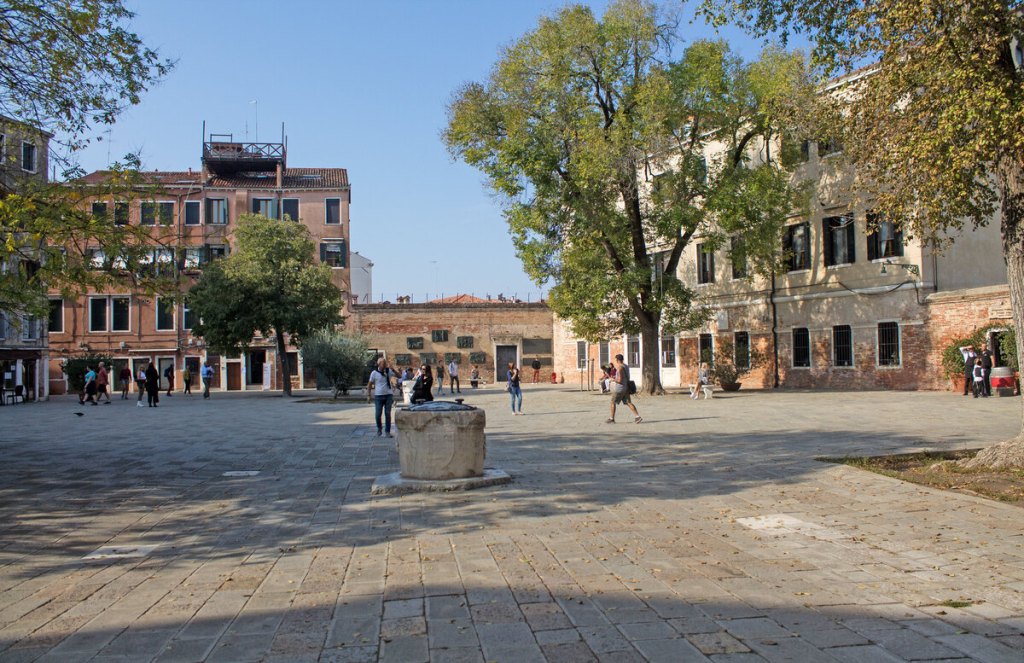
The Venetian Ghetto is much more than just a Jewish quarter: it’s steeped in history and is where the word “ghetto” comes from. The term derives from the Italian word getto, referring to the pouring of molten metal in the foundry that once existed in the area, and the term then entered into common use to refer to the quarters to which Jews were confined.
The Ghetto, a microcosm of great cultural and religious vitality where Jews have preserved and continue to preserve their traditions and identity, like many other parts of the city has been a film location and a literary setting.
One of the most famous works set in this area is of course Shakespeare’s The Merchant of Venice, which tells the story of the rich Jew Shylock, the protagonist of a tale in which he is faced with antisemitism and intolerance. The tragedy has been told in almost 40 different versions on the big and small screen, in both feature films and shorts. Another story in which the Venetian Ghetto has played a key role is the one told in Senso, a film by Luchino Visconti, based on Camillo Boito’s novella of the same name. In this melodrama, set in Venice in 1866, the ghetto provides the backdrop for a love affair between a Venetian noblewoman and an Austrian officer. Other locations for the film are the La Fenice opera house and the Arsenal.
The Rialto Bridge
The Rialto Bridge, with its unmistakeable white form and the shops adorning it, is another well-known symbol of Venice. This bridge, linking the districts of San Marco and San Polo, existed as early as the 12th century as a wooden structure, but has been rebuilt several times due to fires and the bridge collapsing. The current structure, in Istrian stone, dates back to the 16th century and is the work of the architect Antonio da Ponte.
A short walk from the famous fish market, bursting with life and colour and a source of inspiration for poets and artists, the bridge has appeared in various films and books set in Venice. One example is Anonimo Veneziano (The Anonymous Venetian), a 1970 film directed by Enrico Maria Salerno, with the screenplay written by Giuseppe Berto, the author of the book of the same name published some years earlier.

Piazza San Marco
St. Mark’s Square, the heart of Venice, is much more than just a square; it’s an outdoor living room, a stage on which history, art and everyday life have been intertwined for centuries and which has become a world-famous icon, along with the splendid Basilica, a true symbol of Venice.
Witness to coronations, festivals and processions, the square has often provided the backdrop for stories that have held us in suspense, in the cinema or as we turn the pages of a book. It was immortalised in Nosferatu a Venezia (Vampire in Venice), a 1988 horror film directed by Augusto Caminito, in which the square is shown in all its disturbing beauty in a foggy, mysterious Venice. More recently, in 2019, Piazza San Marco also featured in Spider-Man: Far From Home, where the young Peter Parker finds himself in the city while on a school trip.
Dan Brown, meanwhile, links both film and literature, with his choice of Venice as one of the settings for his novel Inferno. In the film based on the book, released in 2016, Tom Hanks, in the guise of Robert Langdon, unravels one of the many riddles in St. Mark’s Basilica itself.
And still in St. Mark’s Square, we have to mention the Marciana National Library, which also appears in The Tourist, and the Grancaffè Quadri, a real institution in the city. Founded in 1638, this café has attracted writers, artists and celebrities from all walks of life throughout the centuries, becoming the place to go for high society and a symbol of Venetian elegance, and it in fact appears in Visconti’s Senso, mentioned earlier.

Palazzo Ducale
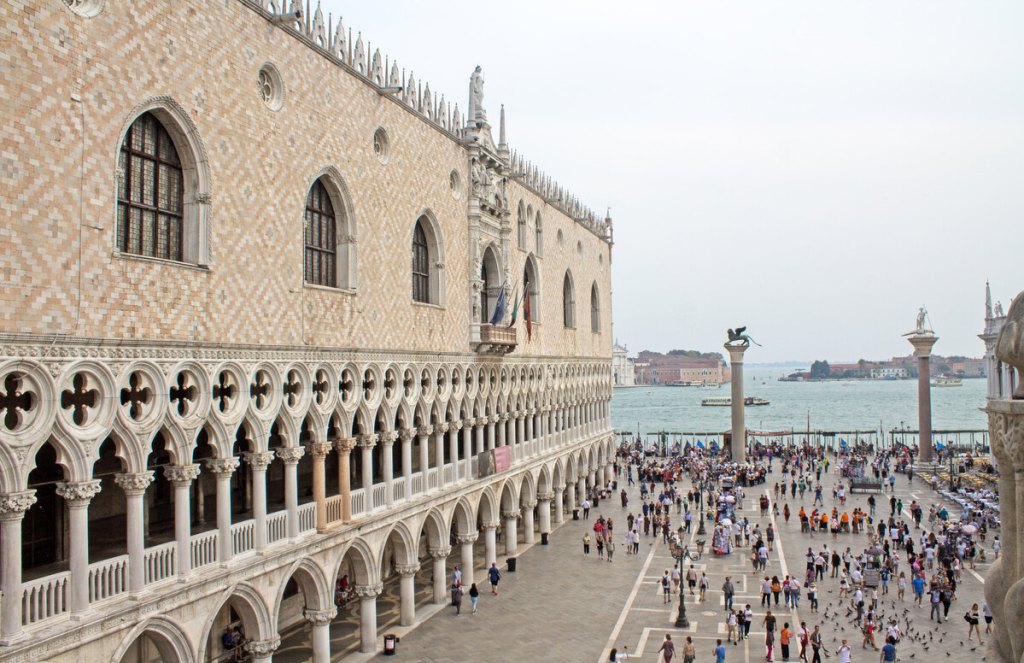
The Doge’s Palace, a jewel of Venetian gothic architecture, has for centuries been the symbol of the power and splendour of Venice. Originally a ninth-century fortress, the building has undergone numerous modifications and transformations following events in the Republic of Venice and in line with the different styles that have characterised the city’s architecture.
The residence of the doges, the seat of government and the scene of key historic events, with its halls adorned with frescoes and works by masters such as Tintoretto and Titian, the Doge’s Palace has featured in some of cinema’s most famous stories and in literature, for example, in one of Shakespeare’s most popular tragedies, Othello. There are in fact over 20 different versions of the tale of the jealous and manipulated Moor of Venice: the first in 1906, the most recent in 2009, and including the famous 1952 version directed by Orson Welles, also bringing to the screen the magnificent spiral staircase of the Palazzo Contarini del Bovolo.
The films that have paid homage to Venice and its palace also include the 2009 film Casanova, with Heath Ledger playing the famous seducer, where, between plot twists and rococo settings, the Doge’s Palace provides the backdrop for amorous intrigues and daring adventures. Some scenes, whilst set inside the palace, were in fact filmed in the Scuola Grande di San Rocco.
The Basilica of Santa Maria della Salute
The Basilica of Santa Maria della Salute, with its impressive dome overlooking St. Mark’s Basin, is one of Venice’s most iconic monuments. Built in the 17th century and dedicated to the Virgin Mary, following the dreadful plague that decimated the city, the Salute is much more than simply a church; it’s a symbol of the faith, hope and resilience of the Venetian people.
Its construction, entrusted to the young architect Baldassare Longhena, is a baroque masterpiece, characteristically octagonal in shape, with an impressive dome and ornately decorated on the exterior, making it the only work of its kind. Inside, it is bright and solemn, decorated with the finest marble and housing works of art by masters such as Tintoretto and Tiepolo.
The Basilica is a much-loved place of worship among Venetians, to the extent that every year, on 21 November, the feast day of the Madonna della Salute, a temporary pontoon bridge is erected to enable the many faithful to cross the Grand Canal more easily and to reach the basilica faster.
Like many other symbolic sites in Venice, the Basilica has also appeared on the big screen several times. Among other directors, Iain Softley chose it as a location, for his film The Wings of a Dove, which also features the San Trovaso boatyard and the squares of Campo di Santa Maria Formosa and Campo dei Frari, and Lasse Hallström used it in his film Casanova, mentioned above.

The Arsenal
The Arsenal is true testimony to the magnitude of Venice. Its origins date back to the 12th century, when it was seen to be the beating heart of the Venetian fleet, eventually becoming the centre of a real industrial revolution. Thousands of artisans, from ship’s carpenters to blacksmiths, worked together here for centuries building ships of every kind, installing the latest nautical technologies of the time.
But the Arsenal was not just a shipyard; it was also a living organism, producing arms, sails, ropes and everything required to equip a fleet, and a kind of assembly line ahead of its time, where each production process was subdivided into specific zones and phases and entrusted to specialist craftsmen. This productive efficiency allowed Venice to reign the seas for centuries, controlling key trade routes and playing an essential role in international politics.
Over recent decades, the Arsenal has led a different life. After a long period of decline, it has now undergone major restoration and redevelopment works, becoming an internationally renowned cultural hub, even attracting Hollywood productions that have chosen it as a film location. It was used for the previously mentioned Senso, Indiana Jones and the Last Crusade, Casanova, The Tourist, Spider-Man: Far From Home, and Iago, the latest film based on Shakespeare’s Othello.
Not far from the Arsenal is the charming square (or campo) of San Francesco della Vigna, which appeared in Pane e tulipani (Bread and Tulips), a 2000 film directed by Silvio Soldini. Some scenes were also shot in Piazzale Roma.

Lido di Venezia
The Venice Lido, a long and narrow island stretching between the Lagoon and the Adriatic Sea, was used in medieval times as a first military outpost to defend the city from naval attacks, but over the course of the centuries it eventually became a major tourist spot, even for the Venetians themselves. Its strategic location, just a few minutes from Venice by waterbus, has made it an ideal place for summer holidays, away from the heat and humidity of the city.
The intellectuals, artists and writers who chose to holiday there during the early years of the 20th century helped to create a cosmopolitan and refined atmosphere which, in the 1930s, led to the staging of the first Venice International Film Festival. Since then, the festival has been held every year and is one of the world’s most eagerly awaited film events, as well as being one of the key events of the Venice Biennale.
The Lido is not just known for the festival, however, as its beauty and unique atmosphere have made it a very popular film location. Films that have had scenes shot here include The English Patient, a 1996 film directed by Anthony Minghella and the winner of numerous Oscars, and Death in Venice, by Luchino Visconti, a masterpiece of Italian cinema based on the novel by Thomas Mann and whose main character is an ill composer who spends the last weeks of his life on the Lido.
If you’d like to explore all the other aspects of the city and find more tips for your trip, read the other articles about Venice on the Volotea blog. If you’ve enjoyed this post, don’t forget to share it on your social channels; it could be of help to someone else who, like you, is planning a trip to the Lagoon!